
Sunday, July 22, 2018

AJ Wealth Strategies LLC Boosts Position in Vanguard Long Term Corporate Bond ETF (VCLT)

AJ Wealth Strategies LLC increased its stake in Vanguard Long Term Corporate Bond ETF (NASDAQ:VCLT) by 31.8% during the second quarter, according to its most recent filing with the Securities and Exchange Commission. The firm owned 6,442 shares of the exchange traded fund’s stock after purchasing an additional 1,554 shares during the quarter. AJ Wealth Strategies LLC’s holdings in Vanguard Long Term Corporate Bond ETF were worth $564,000 at the end of the most recent quarter.

Several other large investors also recently bought and sold shares of the stock. NYL Investors LLC bought a new stake in Vanguard Long Term Corporate Bond ETF during the 1st quarter valued at $40,701,000. Nisa Investment Advisors LLC bought a new stake in Vanguard Long Term Corporate Bond ETF during the 2nd quarter valued at $20,453,000. State of Tennessee Treasury Department raised its holdings in Vanguard Long Term Corporate Bond ETF by 7.5% during the 1st quarter. State of Tennessee Treasury Department now owns 775,100 shares of the exchange traded fund’s stock valued at $70,813,000 after acquiring an additional 54,400 shares during the period. Envestnet Asset Management Inc. raised its holdings in Vanguard Long Term Corporate Bond ETF by 26.9% during the 4th quarter. Envestnet Asset Management Inc. now owns 251,235 shares of the exchange traded fund’s stock valued at $24,055,000 after acquiring an additional 53,221 shares during the period. Finally, Royal Bank of Canada raised its holdings in Vanguard Long Term Corporate Bond ETF by 12.1% during the 1st quarter. Royal Bank of Canada now owns 396,129 shares of the exchange traded fund’s stock valued at $36,190,000 after acquiring an additional 42,752 shares during the period.

Get Vanguard Long Term Corporate Bond ETF alerts:

VCLT stock traded up $0.44 during midday trading on Thursday, reaching $88.95. 286,320 shares of the company’s stock traded hands, compared to its average volume of 255,107. Vanguard Long Term Corporate Bond ETF has a 52 week low of $86.70 and a 52 week high of $96.52.

The firm also recently announced a monthly dividend, which was paid on Friday, July 6th. Shareholders of record on Tuesday, July 3rd were issued a dividend of $0.305 per share. The ex-dividend date was Monday, July 2nd. This represents a $3.66 dividend on an annualized basis and a yield of 4.11%.

About Vanguard Long Term Corporate Bond ETF

Vanguard Long Term Corporate Bond ETF (the Fund) seeks to track the performance of a market-weighted corporate bond index with a long-term, dollar-weighted average maturity. The Fund employs a passive management or indexing investment approach designed to track the performance of the Barclays Capital U.S.

Featured Article: Understanding Price to Earnings Ratio (PE)

Want to see what other hedge funds are holding VCLT? Visit HoldingsChannel.com to get the latest 13F filings and insider trades for Vanguard Long Term Corporate Bond ETF (NASDAQ:VCLT).


Institutional Ownership by Quarter for Vanguard Long Term Corporate Bond ETF (NASDAQ:VCLT)

Thursday, July 19, 2018

Stanley Black & Decker, Inc. (SWK) Shares Bought by Cornerstone Investment Partners LLC

Cornerstone Investment Partners LLC raised its position in shares of Stanley Black & Decker, Inc. (NYSE:SWK) by 14.8% during the 2nd quarter, according to the company in its most recent 13F filing with the SEC. The fund owned 334,708 shares of the industrial products company’s stock after purchasing an additional 43,134 shares during the quarter. Stanley Black & Decker accounts for 2.0% of Cornerstone Investment Partners LLC’s portfolio, making the stock its 29th largest position. Cornerstone Investment Partners LLC owned approximately 0.22% of Stanley Black & Decker worth $44,453,000 at the end of the most recent reporting period.

A number of other institutional investors have also recently bought and sold shares of SWK. Renaissance Technologies LLC purchased a new stake in Stanley Black & Decker during the 4th quarter valued at about $16,216,000. Stone Ridge Asset Management LLC purchased a new stake in Stanley Black & Decker during the 4th quarter valued at about $448,000. Cornerstone Capital Management Holdings LLC. grew its stake in Stanley Black & Decker by 13.9% during the 4th quarter. Cornerstone Capital Management Holdings LLC. now owns 29,879 shares of the industrial products company’s stock valued at $5,069,000 after purchasing an additional 3,635 shares during the last quarter. LPL Financial LLC grew its stake in Stanley Black & Decker by 2.4% during the 4th quarter. LPL Financial LLC now owns 33,421 shares of the industrial products company’s stock valued at $5,671,000 after purchasing an additional 776 shares during the last quarter. Finally, MetLife Investment Advisors LLC purchased a new stake in Stanley Black & Decker during the 4th quarter valued at about $8,052,000. Institutional investors and hedge funds own 82.56% of the company’s stock.

Get Stanley Black & Decker alerts:

Several research firms have weighed in on SWK. Zacks Investment Research downgraded Stanley Black & Decker from a “hold” rating to a “sell” rating in a research note on Monday, April 2nd. B. Riley reiterated a “buy” rating on shares of Stanley Black & Decker in a research note on Thursday, June 7th. Morgan Stanley dropped their price target on Stanley Black & Decker from $178.00 to $162.00 and set an “overweight” rating on the stock in a research note on Monday, April 23rd. ValuEngine downgraded Stanley Black & Decker from a “buy” rating to a “hold” rating in a research note on Saturday, April 21st. Finally, Northcoast Research set a $182.00 target price on Stanley Black & Decker and gave the stock a “buy” rating in a research note on Tuesday, April 24th. Two analysts have rated the stock with a sell rating, four have assigned a hold rating and thirteen have issued a buy rating to the company. The stock presently has an average rating of “Buy” and an average target price of $181.00.

In other Stanley Black & Decker news, Director Michael David Hankin purchased 350 shares of Stanley Black & Decker stock in a transaction that occurred on Friday, April 27th. The stock was bought at an average price of $143.28 per share, with a total value of $50,148.00. Following the acquisition, the director now owns 1,250 shares of the company’s stock, valued at approximately $179,100. The acquisition was disclosed in a filing with the Securities & Exchange Commission, which is available through this hyperlink. Corporate insiders own 0.69% of the company’s stock.

Shares of SWK traded up $1.20 during mid-day trading on Tuesday, reaching $135.71. The company had a trading volume of 1,319,272 shares, compared to its average volume of 1,249,886. Stanley Black & Decker, Inc. has a 52-week low of $130.56 and a 52-week high of $176.62. The company has a quick ratio of 0.57, a current ratio of 1.06 and a debt-to-equity ratio of 0.37. The company has a market capitalization of $20.92 billion, a price-to-earnings ratio of 18.21, a PEG ratio of 1.57 and a beta of 1.00.

Stanley Black & Decker (NYSE:SWK) last issued its earnings results on Friday, April 20th. The industrial products company reported $1.39 EPS for the quarter, topping analysts’ consensus estimates of $1.35 by $0.04. Stanley Black & Decker had a return on equity of 15.65% and a net margin of 7.63%. The firm had revenue of $3.21 billion for the quarter, compared to the consensus estimate of $3.10 billion. During the same quarter in the prior year, the business earned $1.29 earnings per share. The company’s revenue was up 12.4% compared to the same quarter last year. equities analysts anticipate that Stanley Black & Decker, Inc. will post 8.41 EPS for the current fiscal year.

The firm also recently declared a quarterly dividend, which was paid on Tuesday, June 19th. Investors of record on Wednesday, June 6th were issued a $0.63 dividend. The ex-dividend date was Tuesday, June 5th. This represents a $2.52 dividend on an annualized basis and a yield of 1.86%. Stanley Black & Decker’s payout ratio is 33.83%.

Stanley Black & Decker Profile

Stanley Black & Decker, Inc provides tools and storage, engineered fastening and infrastructure, and security solutions worldwide. The company's Tools & Storage segment offers professional products, including corded and cordless electric power tools and equipment, drills, impact wrenches and drivers, grinders, saws, routers, and sanders, as well as pneumatic tools and fasteners, including nail guns, nails, staplers and staples, and concrete and masonry anchors; and consumer products, such as lawn and garden products comprising hedge and string trimmers, lawn mowers, and edgers and related accessories, as well as home products, such as hand-held vacuums, paint tools, and cleaning appliances.

Recommended Story: What does EPS mean?

Want to see what other hedge funds are holding SWK? Visit HoldingsChannel.com to get the latest 13F filings and insider trades for Stanley Black & Decker, Inc. (NYSE:SWK).

Institutional Ownership by Quarter for Stanley Black & Decker (NYSE:SWK)

Wednesday, July 11, 2018

Best Casino Stocks For 2019

tags:KLXI,BRCM,MVIS,CRECF,

This article is reprinted by permission from NextAvenue.org.

1. Margaritaville

Jimmy Buffett sure knows how to make the most of a catchy tune and a party vibe. Somehow the 70-year-old singer-songwriter has turned ��wasting away again in Margaritaville�� into an aspirational goal. True, ��nibblin�� on sponge cake, watchin�� the sun bake�� does sound pretty nice (especially on a cold gray day in March). That laid-back sensibility is what attracts visitors to his sprawling collection of Margaritaville restaurants, casinos, hotels and resorts around the globe. And now there��s another option for folks who can��t get enough of the ��Margaritaville state of mind�� he peddles. Buffett has announced that he��s opening a string of Margaritaville retirement communities in 2017. Which got us thinking: Which other songs could be spun into successful themed retirement communities? Quite a few, it turns out.

Best Casino Stocks For 2019: KLX Inc.(KLXI)

Advisors' Opinion:
  • [By Joseph Griffin]

    Get a free copy of the Zacks research report on KLX (KLXI)

    For more information about research offerings from Zacks Investment Research, visit Zacks.com

  • [By Logan Wallace]

    OppenheimerFunds Inc. decreased its position in KLX Inc (NASDAQ:KLXI) by 16.2% in the 1st quarter, Holdings Channel reports. The firm owned 7,067 shares of the aerospace company’s stock after selling 1,367 shares during the period. OppenheimerFunds Inc.’s holdings in KLX were worth $502,000 as of its most recent filing with the Securities and Exchange Commission.

  • [By Max Byerly]

    BidaskClub downgraded shares of KLX (NASDAQ:KLXI) from a buy rating to a hold rating in a report released on Tuesday morning.

    KLXI has been the subject of several other reports. SunTrust Banks cut shares of KLX from a buy rating to a hold rating and set a $53.00 target price for the company. in a report on Wednesday, May 2nd. Zacks Investment Research cut shares of KLX from a buy rating to a hold rating in a report on Saturday, February 17th. TheStreet cut shares of KLX from a b rating to a c+ rating in a report on Tuesday, March 6th. Finally, Jefferies Group upgraded shares of KLX from a hold rating to a buy rating in a report on Wednesday, March 7th. Four equities research analysts have rated the stock with a hold rating and three have assigned a buy rating to the company. The company presently has an average rating of Hold and a consensus target price of $66.50.

  • [By Ethan Ryder]

    Millennium Management LLC lifted its holdings in KLX Inc (NASDAQ:KLXI) by 537.9% in the 1st quarter, according to the company in its most recent 13F filing with the Securities and Exchange Commission. The fund owned 1,809,642 shares of the aerospace company’s stock after purchasing an additional 1,525,961 shares during the period. Millennium Management LLC’s holdings in KLX were worth $128,593,000 at the end of the most recent reporting period.

Best Casino Stocks For 2019: Broadcom Corporation(BRCM)

Advisors' Opinion:
  • [By Paul Ausick]

    Broadcom Inc. (NASDAQ: BRCM) traded down about 1.4% Friday and posted a new 52-week low of $222.00 after closing Thursday at $225.25. The stock’s 52-week high is $285.68. Volume totaled around 3.9 million, just under the daily average of about 4.1 million. The company had no specific news.

  • [By Max Byerly]

    Headlines about Broadcom (NASDAQ:BRCM) have trended somewhat positive this week, according to Accern Sentiment. The research firm scores the sentiment of media coverage by reviewing more than 20 million news and blog sources. Accern ranks coverage of companies on a scale of negative one to positive one, with scores closest to one being the most favorable. Broadcom earned a news impact score of 0.16 on Accern’s scale. Accern also gave media headlines about the semiconductor manufacturer an impact score of 43.7335359332371 out of 100, indicating that recent media coverage is somewhat unlikely to have an impact on the company’s share price in the near future.

Best Casino Stocks For 2019: Microvision Inc.(MVIS)

Advisors' Opinion:
  • [By Max Byerly]

    IMPINJ (NASDAQ: PI) and MicroVision (NASDAQ:MVIS) are both small-cap computer and technology companies, but which is the superior business? We will contrast the two companies based on the strength of their dividends, profitability, risk, valuation, institutional ownership, analyst recommendations and earnings.

Best Casino Stocks For 2019: Critical Elements Corporation (CRECF)

Advisors' Opinion:
  • [By ]

    The following 6 companies are on the bench for the index:

    Advantage Lithium (OTCQX:AVLIF) Argosy Minerals (OTCPK:ARYMF) Bacanora Minerals (OTC:BCRMF) Critical Elements (OTCQX:CRECF) NEO Lithium (OTCQX:NTTHF) Wealth Minerals (OTCQX:WMLLF)

    "Bench" is a sports analogy meaning that one or more of them could be added in the future if one of the above companies becomes a producer, is acquired, or the market capitalization ("cap") of one or more of the index holdings falls significantly below that of one or more companies on the bench.

  • [By ]

    Other juniors include: Advantage Lithium (OTCQB:AVLIF) [TSXV:AAL], AIS Resources [TSXV:AIS] (OTCQB:AISSF), American Lithium Corp. [TSX-V: LI] (OTCQB:LIACF), Argentina Lithium and Energy Corp. [TSXV:LIT] (OTCQB:PNXLF), Argosy Minerals [ASX:AGY] (OTC:ARYMF), AVZ Minerals [ASX:AVZ] (OTC:AZZVF), Bacanora Minerals [TSXV:BCN] [AIM:BCN] [GR:1BQ] (OTC:BCRMF), Birimian Ltd [ASX:BGS] (OTC:EEYMF), Critical Elements [TSXV:CRE] [GR:F12] (OTCQX:CRECF), Dajin Resources [TSXV:DJI] (OTCPK:DJIFF), Enigri (private), Eramet (EN Paris:ERA) (OTCPK:ERMAY), European Metals Holdings [ASX:EMH] [AIM:EMH] [GR:E861] (OTC:ERPNF), Far Resources [CSE:FAT] (OTCPK:FRRSF), Force Commodities [ASX:4CE], Kidman Resources [ASX:KDR] [GR:6KR], Latin Resources Ltd [ASX: LRS] (OTC:LAXXF), Lithium Australia [ASX:LIT] (OTC:LMMFF), Lithium Power International [ASX:LPI] (OTC:LTHHF), LSC Lithium [TSXV:LSC] (OTC:LSSCF), MetalsTech [ASX:MTC], MGX Minerals [CSE:XMG] (OTC:MGXMF), Millennial Lithium Corp. [TSXV:ML] (OTCQB:MLNLF), Neo Lithium [TSXV:NLC] (OTC:NTTHF), NRG Metals Inc. [TSXV:NGZ] (OTCQB:NRGMF), Nemaska Lithium [TSX:NMX] [GR:NOT] (OTCQX:NMKEF), North American Lithium (private), Piedmont Lithium [ASX:PLL] (OTC:PLLLY), Prospect Resources [ASX:PSC], Sayona Mining [ASX:SYA] (OTCPK:DMNXF), Savannah Resources [LSE:SAV], Standard Lithium [TSXV:SLL] (OTC:STLHF), and Wealth Minerals [TSXV:WML] (OTCQB:WMLLF).

Tuesday, July 10, 2018

Reviewing Energy XXI Gulf Coast (EGC) & Pioneer Natural Resources (PXD)

Energy XXI Gulf Coast (NASDAQ: EGC) and Pioneer Natural Resources (NYSE:PXD) are both oils/energy companies, but which is the superior business? We will contrast the two businesses based on the strength of their earnings, valuation, dividends, profitability, analyst recommendations, institutional ownership and risk.

Dividends

Get Energy XXI Gulf Coast alerts:

Pioneer Natural Resources pays an annual dividend of $0.32 per share and has a dividend yield of 0.2%. Energy XXI Gulf Coast does not pay a dividend. Pioneer Natural Resources pays out 14.8% of its earnings in the form of a dividend.

Risk and Volatility

Energy XXI Gulf Coast has a beta of 3.37, indicating that its stock price is 237% more volatile than the S&P 500. Comparatively, Pioneer Natural Resources has a beta of 0.92, indicating that its stock price is 8% less volatile than the S&P 500.

Earnings & Valuation

This table compares Energy XXI Gulf Coast and Pioneer Natural Resources’ gross revenue, earnings per share and valuation.

Gross Revenue Price/Sales Ratio Net Income Earnings Per Share Price/Earnings Ratio
Energy XXI Gulf Coast $511.64 million 0.59 -$341.01 million ($4.59) -1.96
Pioneer Natural Resources $5.46 billion 5.78 $833.00 million $2.16 85.66

Pioneer Natural Resources has higher revenue and earnings than Energy XXI Gulf Coast. Energy XXI Gulf Coast is trading at a lower price-to-earnings ratio than Pioneer Natural Resources, indicating that it is currently the more affordable of the two stocks.

Profitability

This table compares Energy XXI Gulf Coast and Pioneer Natural Resources’ net margins, return on equity and return on assets.

Net Margins Return on Equity Return on Assets
Energy XXI Gulf Coast -63.63% -50.61% -11.74%
Pioneer Natural Resources 15.56% 5.57% 3.64%

Analyst Recommendations

This is a breakdown of current ratings and price targets for Energy XXI Gulf Coast and Pioneer Natural Resources, as reported by MarketBeat.com.

Sell Ratings Hold Ratings Buy Ratings Strong Buy Ratings Rating Score
Energy XXI Gulf Coast 0 0 0 0 N/A
Pioneer Natural Resources 0 4 26 1 2.90

Pioneer Natural Resources has a consensus target price of $222.51, indicating a potential upside of 20.26%. Given Pioneer Natural Resources’ higher possible upside, analysts clearly believe Pioneer Natural Resources is more favorable than Energy XXI Gulf Coast.

Insider and Institutional Ownership

68.5% of Energy XXI Gulf Coast shares are owned by institutional investors. Comparatively, 87.5% of Pioneer Natural Resources shares are owned by institutional investors. 0.7% of Energy XXI Gulf Coast shares are owned by insiders. Comparatively, 0.9% of Pioneer Natural Resources shares are owned by insiders. Strong institutional ownership is an indication that endowments, large money managers and hedge funds believe a stock is poised for long-term growth.

Summary

Pioneer Natural Resources beats Energy XXI Gulf Coast on 14 of the 16 factors compared between the two stocks.

About Energy XXI Gulf Coast

Energy XXI Gulf Coast, Inc., an exploration and production company, engages in the acquisition, development, exploitation, and operation of oil and natural gas properties in the United States Gulf Coast region. It primarily operates properties offshore on the Gulf of Mexico Shelf, as well as onshore in Louisiana and Texas. As of December 31, 2017, the company had total proved reserves of 88.2 million barrel of oil equivalent; and operated or had an interest in 577 gross producing wells on 421,974 net developed acres, including interests in 55 producing fields. Energy XXI Gulf Coast, Inc. was incorporated in 2006 and is headquartered in Houston, Texas.

About Pioneer Natural Resources

Pioneer Natural Resources Company operates as an independent oil and gas exploration and production company in the United States. The company explores for, develops, and produces oil, natural gas liquids (NGLs), and gas. It has operations primarily in the Permian Basin in West Texas, the Eagle Ford Shale play in South Texas, the Raton field in southeast Colorado, and the West Panhandle field in the Texas Panhandle. As of December 31, 2017, the company had proved undeveloped reserves and proved developed reserves of approximately 45 million barrels of oil, 22 million barrels of NGLs, and 291 billion cubic feet of gas; and owned interests in 10 gas processing plants and 4 treating facilities. Pioneer Natural Resources Company is headquartered in Irving, Texas.
Monday, July 9, 2018

China says the US has started 'the biggest trade war' in history

China on Friday accused the United States of starting "the biggest trade war in economic history" as US tariffs took effect on Chinese goods worth $34 billion.

"China is forced to strike back to safeguard core national interests and the interests of its people," the country's Commerce Ministry said in a statement after US tariffs kicked in just after midnight ET, which is noon in Beijing.

The Trump administration's 25% tariffs are targeting Chinese products such as industrial machinery, medical devices and auto parts.

The Commerce Ministry statement didn't provide details on its retaliation. Beijing has said previously it would fire back against an equal value of US exports, including SUVs, meat and seafood.

Even before Friday, the trade dispute between the world's top two economies had rattled markets and prompted warnings from companies of damage to their bottom lines and higher prices for consumers.

The big question is how far the hostilities between Washington and Beijing will go.

The United States is also set to impose 25% tariffs on another $16 billion in Chinese exports later in the summer, and China has vowed to retaliate against US goods worth a similar amount.

Economists say that if the back-and-forth stops there, the overall impact on both economies will be minimal even though some industries will suffer.

But Trump has said his administration will respond to retaliation from Beijing with much bigger waves of tariffs, raising the prospect of worsening tit-for-tat reprisals. On Thursday, he suggested the possibility of tariffs on almost $500 billion more of Chinese goods.

He described the potential escalation to reporters aboard Air Force One: "Thirty-four, and then you have another 16 in two weeks and then, as you know, we have 200 billion in abeyance and then after the 200 billion we have 300 billion in abeyance. OK?" Trump said. "So we have 50 plus 200 plus almost 300."

That amount is higher than an earlier threat from Trump to target as much as $450 billion of Chinese exports. It's also bigger than the $505 billion of goods that the United States imported from China last year.

This is what a trade war  looks like This is what a trade war looks like
Trading accusations

Trump and his advisers argue the tariffs are necessary to pressure China into abandoning unfair practices such as stealing intellectual property and forcing American companies to hand over valuable technology.

Beijing denies it's in the wrong and says it's ready to fight a trade war until the end.

"The United States will be opening fire on the whole world and also opening fire on itself," Chinese Commerce Ministry spokesman Gao Feng told reporters on Thursday. He warned that the US tariffs will hurt a lot of foreign companies that export goods from China to the United States.

Underpinning the dispute about technology is Trump's anger at America's $375 billion deficit in goods trade with China. But after three rounds of negotiations between the two sides, including a Chinese pledge to significantly increase purchases of American products, Trump decided to go ahead with the tariffs.

The clash with China comes as the Trump administration is also fighting over trade with American allies such as Canada and the European Union. US tariffs on steel and aluminum imports have provoked retaliatory measures against billions of dollars of American exports. Trump has added to the tension by threatening new tariffs on cars.

For the time being, analysts say it's hard to see Washington or Beijing backing down in the dispute.

"By threatening unilateral action without having any allies and not reducing domestic discord on trade, the Trump administration has invited China to stand tough," said Scott Kennedy, director of the Project on Chinese Business and Political Economy at the Center for Strategic and International Studies.

"The Trump administration also believes that at least starting a trade war is in its interests; the US economy is strong enough to endure a crimp in trade, the president's domestic political standing is as strong as ever amongst Republicans, and pushing China hard on trade may help restore US credibility on other issues," he added.

Reaching a deal will be tough

The two giant economies appear ready to see which side can endure the most pain. The damage could also spread to other economies, hurting business confidence and prompting companies to delay investments.

Kennedy say he thinks the Trump administration's enthusiasm for the conflict "will erode as the economic pain and political fallout from a trade war begin to take hold. At that point, the US will be more interested in negotiations, and the Chinese side will also want to come to the table."

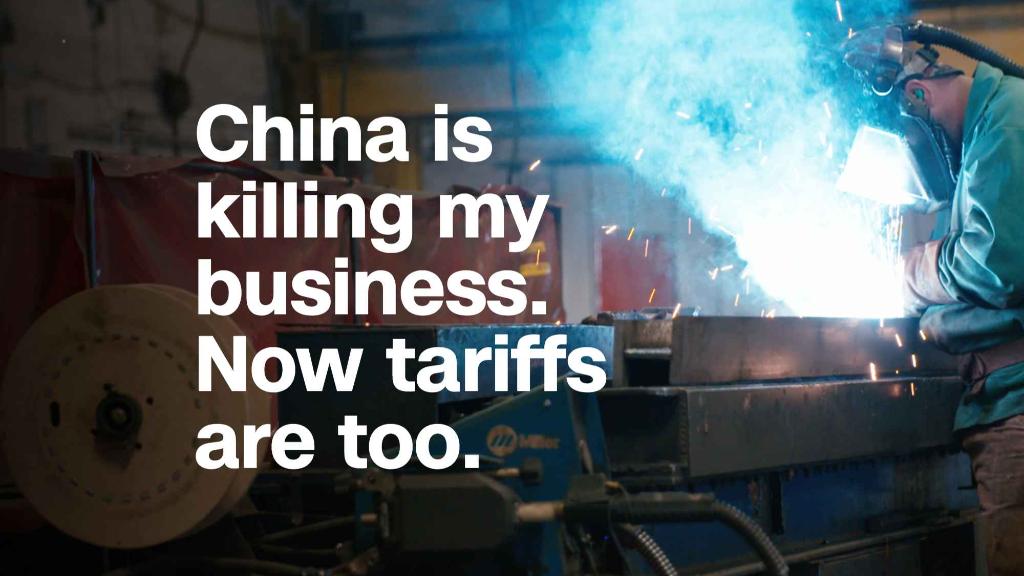
China is killing my business. Now tariffs are too. China is killing my business. Now tariffs are too.

But reaching a deal that's palatable to both sides will be tough. For example, the US government wants China to rein in government subsidies for policies like "Made in China 2025," which seeks to pump hundreds of billions of dollars into industries such as robotics, electric cars and computer chips with the aim of becoming a global leader.

Analysts say China is unlikely to budge on those plans, which it sees as crucial for developing its huge economy.

"It's still hard for me to believe the Trump administration could develop and negotiate an overarching package with China that genuinely sticks," Kennedy said. "And so I'd expect the two sides to pursue some sort of face-saving deal that looks good on paper but is not enduring."

-- Steven Jiang and Kevin Liptak contributed to this report.