Wednesday, August 8, 2018

Allen L. Dittrich Sells 4,000 Shares of Duluth Holdings Inc (DLTH) Stock

Duluth Holdings Inc (NASDAQ:DLTH) SVP Allen L. Dittrich sold 4,000 shares of the stock in a transaction that occurred on Wednesday, August 1st. The shares were sold at an average price of $22.96, for a total value of $91,840.00. Following the transaction, the senior vice president now owns 196,186 shares in the company, valued at approximately $4,504,430.56. The sale was disclosed in a document filed with the Securities & Exchange Commission, which can be accessed through this hyperlink.

Shares of NASDAQ DLTH opened at $23.31 on Friday. The firm has a market cap of $667.66 million, a price-to-earnings ratio of 36.27, a P/E/G ratio of 1.40 and a beta of -0.22. Duluth Holdings Inc has a 52-week low of $15.13 and a 52-week high of $25.84. The company has a debt-to-equity ratio of 0.26, a current ratio of 1.58 and a quick ratio of 0.17.

Get Duluth alerts:

Duluth (NASDAQ:DLTH) last issued its quarterly earnings data on Tuesday, June 5th. The company reported ($0.02) earnings per share (EPS) for the quarter, beating the Zacks’ consensus estimate of ($0.05) by $0.03. The company had revenue of $100.20 million during the quarter, compared to analysts’ expectations of $100.23 million. Duluth had a return on equity of 15.77% and a net margin of 4.57%. The business’s revenue was up 19.7% on a year-over-year basis. During the same period last year, the business earned $0.01 earnings per share. sell-side analysts predict that Duluth Holdings Inc will post 0.81 earnings per share for the current year.

Several equities research analysts have recently issued reports on DLTH shares. Zacks Investment Research upgraded shares of Duluth from a “sell” rating to a “hold” rating in a research note on Tuesday, May 22nd. ValuEngine upgraded shares of Duluth from a “hold” rating to a “buy” rating in a research note on Thursday, June 21st. BidaskClub downgraded shares of Duluth from a “buy” rating to a “hold” rating in a research note on Saturday, April 28th. William Blair raised Duluth from a “market perform” rating to an “outperform” rating in a research report on Friday, June 29th. Finally, DA Davidson reaffirmed a “buy” rating on shares of Duluth in a research report on Friday, June 1st. Five equities research analysts have rated the stock with a hold rating and six have assigned a buy rating to the company’s stock. Duluth currently has an average rating of “Buy” and a consensus price target of $21.17.

Several hedge funds and other institutional investors have recently modified their holdings of the business. Perkins Capital Management Inc. bought a new position in shares of Duluth during the second quarter valued at $321,000. Migdal Insurance & Financial Holdings Ltd. lifted its holdings in shares of Duluth by 39.7% during the second quarter. Migdal Insurance & Financial Holdings Ltd. now owns 12,999 shares of the company’s stock valued at $309,000 after acquiring an additional 3,692 shares during the period. Mesirow Financial Investment Management Inc. lifted its holdings in shares of Duluth by 17.1% during the second quarter. Mesirow Financial Investment Management Inc. now owns 23,809 shares of the company’s stock valued at $566,000 after acquiring an additional 3,474 shares during the period. Dynamic Technology Lab Private Ltd bought a new position in shares of Duluth during the first quarter valued at $453,000. Finally, Barclays PLC lifted its holdings in shares of Duluth by 1,452.0% during the first quarter. Barclays PLC now owns 24,971 shares of the company’s stock valued at $467,000 after acquiring an additional 23,362 shares during the period. 44.45% of the stock is owned by institutional investors.

Duluth Company Profile

Duluth Holdings Inc sells casual wear, workwear, and accessories for men and women under the Duluth Trading brand in the United States. It provides shirts, pants, underwear, tanks, outerwear, footwear, accessories, and hard goods. The company offers its products under various trademarks, trade names, and service marks, including Alaskan Hardgear, Armachillo, Ballroom, Bucket Master, Cab Commander, Crouch Gusset, Dry on the Fly, Duluth Trading Co, Duluthflex, Fire Hose, Longtail T, No-Yank, No Polo Shirt, Wild Boar Mocs, and Buck Naked.

Further Reading: Book Value Per Share �� BVPS

Insider Buying and Selling by Quarter for Duluth (NASDAQ:DLTH)

Friday, August 3, 2018

Taco Bell Drops the Drive-Thru for Its Urban Evolution

In recent years, Taco Bell has been an innovation leader in the fast-food world. You may not consider all of the chain's edible experiments to have been positives, but items like the Naked Chicken Chalupa, Nacho fries, and (most important) Doritos Locos Taco have been major sales drivers for the Yum! Brands (NYSE:YUM) unit.

Wacky food, however, is not the only area where the company has been experimenting -- it has been reinventing its restaurant designs, too. In the past year, the company has opened a total of 16 "urban inline" stores -- smaller locations that lack drive-thru windows -- and Cantinas -- eateries that serve an entirely different, more upscale, menu, and in some cases, alcohol.

Now, adding detail to plans first revealed in fall 2017,�Taco Bell says it will undertake a major expansion using those new store models. The blueprint includes adding 125 locations in metro New York -- a market that Yum! described as underserved by Taco Bell -- over the next five years. It's part of a broader goal of opening 1,000 new U.S, restaurants -- including 300 of those two new concepts -- by 2022.

Taco Bell Nacho fries

Taco Bell has been a menu innovator. Image source: Getty Images.

A growing brand

Taco Bell has already opened 90 new U.S. locations so far in 2018, and it has plans to add 100 more by the end of the year. The chain also has 500 international locations, and intends to grow that number to 1,000 by the end of 2022.

The company seems most excited by its new concepts, as they allow it to expand into highly walkable locales where its older store designs would have been a poor match. "Whether it's in the heart of New York City, or steps from the boardwalk in Newport Beach, these restaurants are designed to fit their local community, with open-kitchen concepts, local artwork, shareable tapas-style menus, free WiFi for customers, outlets for charging devices and modern restaurant designs that invite customers to stay and socialize over their meal," the company said in a press release.�

These smaller-format stores vary in size, with the most compact coming in at 1,200 square feet. The chain also plans to install self-ordering kiosks in all of its stores by the end of 2019, and expand its delivery partnership with GrubHub to about 4,500 locations by the end of this year.

Thinking outside the bun -- and the car

For many years, Taco Bell management was married to the idea that all of its locations should have drive-thru windows. That makes sense, given that 55% and 70% of its sales traditionally have been made to drive-thru customers, according to Food & Wine magazine.

But people in big cities aren't in their cars as often suburban customers. They are more likely to order food for delivery, or to arrive at a restaurant on foot. For a chain like�Taco Bell, which has already saturated many of its traditional markets, adapting with formats that let it reach new audiences can only be seen as smart path to growth.

Thursday, August 2, 2018

Apple Hits $1 Trillion Market Cap -- Now What?

Apple Inc. (NASDAQ:AAPL) stock made headlines today by becoming the first public company in history to achieve a market cap of $1 trillion, beating out would-be contenders like Amazon.com, Alphabet, and Microsoft. In order to reach this level, Apple has gained nearly 20% so far in 2018 after a 46% gain last year.

While it may be exciting to see Apple hit this milestone, it's important to remember that this particular watermark is completely arbitrary, and while watching the "race to $1 trillion" made for a bit of fun, it has nothing to do with the ongoing potential of the business. Let's look at the catalysts that precipitated Apple's recent rise and see what that means for its future prospects.

A close-up of $100 bills being printed.

Apple's worth $1 trillion. Now what? Image source: Getty Images.

How did we get here?

Several factors contributed to the company's historic feat. Apple's second-quarter financial report topped analysts' consensus estimates to start the trend. The company said it was "our best March quarter ever."

Apple investors had been downbeat following reports of weak demand for the company's flagship iPhone and weak financial results from Apple's suppliers. The company's surprisingly strong performance went a long way toward soothing shareholder doubts about its future.�

Additionally, Apple revealed a 16% boost to its dividend, the sixth such increase in as many years and the largest to date. This brings the company's payout to $0.73 quarterly per share, currently yielding about 1.57%. Its recent strong earnings mean that Apple still is using less than 25% of its profits to support the payout, so these annual increases will likely continue for the foreseeable future.

Investors in the iPhone maker were given another reason to celebrate, as the company announced a new $100 billion repurchase program, saying that its stock is "undervalued." Apple has a strong record of buying back stock, and has reduced its share count by nearly 22% over the past five years. At Apple's current price, the new buyback plan could reduce the share count by another 10%, giving each shareholder an even larger slice of the Apple pie.

AAPL Shares Outstanding Chart

AAPL Shares Outstanding data by YCharts.

Apple wasn't alone in thinking that its stock was a bargain. Legendary investor and Berkshire Hathaway (NYSE: BRK-A) (NYSE: BRK-B) CEO Warren Buffett revealed in May that the company had purchased an additional 75 million Apple shares, bringing its total holdings to 240 million shares, owning about 5% of the company.

Investors tend to watch Buffett's purchases due to his laudable track record. Since 1965, the Oracle of Omaha has generated compound annual gains of 20.9% for Berkshire, more than double that of the broader market and producing overall stock-price gains of 2,404,748%.�Those results show why investors do well to follow his example.

Still going strong

Apple's compelling results continued into the third quarter, with top and bottom line numbers coming in at the high end of Apple's forecast, beating analysts' consensus estimates in the process. More importantly, customers continued to opt for the higher-end products -- like the iPhone 8 and iPhone X -- increasing the average selling price for the devices to $724, up from $606 in the prior-year quarter. This drove revenue up 17% year over year, while earnings per share jumped 40% compared to the prior-year quarter.

Meanwhile, Apple has been growing its other businesses to reduce its reliance on the iPhone. The company's�services segment is becoming an increasingly important part of the company's strategy. Sales from the services business grew 31% year over year and accounted for 18% of Apple's revenue in the third quarter. The company's other products segment -- which includes Apple Watch, HomePod, Beats, and AirPods -- is also booming, growing 37% year over year, and it now represents 7% of Apple's revenue.

What this means for the future

It turns out that the same things that propelled Apple's shares to these historic heights are the very things that continue to make the stock a compelling investment. Apple has continued to produce strong financial results, a noteworthy feat for an entity of its size.

The company has demonstrated its ability to generate strong revenue, income, and free cash flow. This will continue to support the company's strong capital-return policy, which has been accelerating, and that likely will continue for years to come.

Wednesday, August 1, 2018

OP Coin Market Cap Hits $686,748.00 (OPC)

OP Coin (CURRENCY:OPC) traded 1.6% higher against the US dollar during the 24-hour period ending at 20:00 PM Eastern on July 22nd. One OP Coin coin can currently be bought for $0.0004 or 0.00000005 BTC on major exchanges including CryptoBridge and Cryptopia. OP Coin has a total market cap of $686,748.00 and $1,916.00 worth of OP Coin was traded on exchanges in the last day. During the last seven days, OP Coin has traded up 1.9% against the US dollar.

Here is how related cryptocurrencies have performed during the last day:

Get OP Coin alerts: TokenPay (TPAY) traded down 1.4% against the dollar and now trades at $3.69 or 0.00049863 BTC. GoNetwork (GOT) traded up 3.2% against the dollar and now trades at $0.55 or 0.00007390 BTC. Nectar (NEC) traded up 1.7% against the dollar and now trades at $0.33 or 0.00004439 BTC. SaluS (SLS) traded down 3% against the dollar and now trades at $25.19 or 0.00340417 BTC. HempCoin (THC) traded down 6.6% against the dollar and now trades at $0.0731 or 0.00000988 BTC. ECC (ECC) traded 11.3% lower against the dollar and now trades at $0.0006 or 0.00000008 BTC. Linda (LINDA) traded 5.6% lower against the dollar and now trades at $0.0016 or 0.00000021 BTC. VeriCoin (VRC) traded down 1.7% against the dollar and now trades at $0.31 or 0.00004196 BTC. ToaCoin (TOA) traded 3% lower against the dollar and now trades at $0.0031 or 0.00000041 BTC. Gambit (GAM) traded 11.8% higher against the dollar and now trades at $6.24 or 0.00084540 BTC.

OP Coin Profile

OP Coin (OPC) is a PoW/PoS coin that uses the Scrypt hashing algorithm. It was first traded on November 12th, 2017. OP Coin’s total supply is 2,473,656,069 coins and its circulating supply is 1,858,984,784 coins. The official website for OP Coin is opcoin.info. The Reddit community for OP Coin is /r/OPCoin_official and the currency’s Github account can be viewed here. OP Coin’s official Twitter account is @OPCoin.official and its Facebook page is accessible here.

OP Coin Coin Trading

OP Coin can be purchased on the following cryptocurrency exchanges: Cryptopia and CryptoBridge. It is usually not possible to buy alternative cryptocurrencies such as OP Coin directly using US dollars. Investors seeking to acquire OP Coin should first buy Ethereum or Bitcoin using an exchange that deals in US dollars such as GDAX, Changelly or Coinbase. Investors can then use their newly-acquired Ethereum or Bitcoin to buy OP Coin using one of the aforementioned exchanges.

new TradingView.widget({ “height”: 400, “width”: 650, “symbol”: “OPCUSD”, “interval”: “D”, “timezone”: “Etc/UTC”, “theme”: “White”, “style”: “1”, “locale”: “en”, “toolbar_bg”: “#f1f3f6”, “enable_publishing”: false, “hideideas”: true, “referral_id”: “2588”});

Sunday, July 22, 2018

AJ Wealth Strategies LLC Boosts Position in Vanguard Long Term Corporate Bond ETF (VCLT)

AJ Wealth Strategies LLC increased its stake in Vanguard Long Term Corporate Bond ETF (NASDAQ:VCLT) by 31.8% during the second quarter, according to its most recent filing with the Securities and Exchange Commission. The firm owned 6,442 shares of the exchange traded fund’s stock after purchasing an additional 1,554 shares during the quarter. AJ Wealth Strategies LLC’s holdings in Vanguard Long Term Corporate Bond ETF were worth $564,000 at the end of the most recent quarter.

Several other large investors also recently bought and sold shares of the stock. NYL Investors LLC bought a new stake in Vanguard Long Term Corporate Bond ETF during the 1st quarter valued at $40,701,000. Nisa Investment Advisors LLC bought a new stake in Vanguard Long Term Corporate Bond ETF during the 2nd quarter valued at $20,453,000. State of Tennessee Treasury Department raised its holdings in Vanguard Long Term Corporate Bond ETF by 7.5% during the 1st quarter. State of Tennessee Treasury Department now owns 775,100 shares of the exchange traded fund’s stock valued at $70,813,000 after acquiring an additional 54,400 shares during the period. Envestnet Asset Management Inc. raised its holdings in Vanguard Long Term Corporate Bond ETF by 26.9% during the 4th quarter. Envestnet Asset Management Inc. now owns 251,235 shares of the exchange traded fund’s stock valued at $24,055,000 after acquiring an additional 53,221 shares during the period. Finally, Royal Bank of Canada raised its holdings in Vanguard Long Term Corporate Bond ETF by 12.1% during the 1st quarter. Royal Bank of Canada now owns 396,129 shares of the exchange traded fund’s stock valued at $36,190,000 after acquiring an additional 42,752 shares during the period.

Get Vanguard Long Term Corporate Bond ETF alerts:

VCLT stock traded up $0.44 during midday trading on Thursday, reaching $88.95. 286,320 shares of the company’s stock traded hands, compared to its average volume of 255,107. Vanguard Long Term Corporate Bond ETF has a 52 week low of $86.70 and a 52 week high of $96.52.

The firm also recently announced a monthly dividend, which was paid on Friday, July 6th. Shareholders of record on Tuesday, July 3rd were issued a dividend of $0.305 per share. The ex-dividend date was Monday, July 2nd. This represents a $3.66 dividend on an annualized basis and a yield of 4.11%.

About Vanguard Long Term Corporate Bond ETF

Vanguard Long Term Corporate Bond ETF (the Fund) seeks to track the performance of a market-weighted corporate bond index with a long-term, dollar-weighted average maturity. The Fund employs a passive management or indexing investment approach designed to track the performance of the Barclays Capital U.S.

Featured Article: Understanding Price to Earnings Ratio (PE)

Want to see what other hedge funds are holding VCLT? Visit HoldingsChannel.com to get the latest 13F filings and insider trades for Vanguard Long Term Corporate Bond ETF (NASDAQ:VCLT).

Institutional Ownership by Quarter for Vanguard Long Term Corporate Bond ETF (NASDAQ:VCLT)

Thursday, July 19, 2018

Stanley Black & Decker, Inc. (SWK) Shares Bought by Cornerstone Investment Partners LLC

Cornerstone Investment Partners LLC raised its position in shares of Stanley Black & Decker, Inc. (NYSE:SWK) by 14.8% during the 2nd quarter, according to the company in its most recent 13F filing with the SEC. The fund owned 334,708 shares of the industrial products company’s stock after purchasing an additional 43,134 shares during the quarter. Stanley Black & Decker accounts for 2.0% of Cornerstone Investment Partners LLC’s portfolio, making the stock its 29th largest position. Cornerstone Investment Partners LLC owned approximately 0.22% of Stanley Black & Decker worth $44,453,000 at the end of the most recent reporting period.

A number of other institutional investors have also recently bought and sold shares of SWK. Renaissance Technologies LLC purchased a new stake in Stanley Black & Decker during the 4th quarter valued at about $16,216,000. Stone Ridge Asset Management LLC purchased a new stake in Stanley Black & Decker during the 4th quarter valued at about $448,000. Cornerstone Capital Management Holdings LLC. grew its stake in Stanley Black & Decker by 13.9% during the 4th quarter. Cornerstone Capital Management Holdings LLC. now owns 29,879 shares of the industrial products company’s stock valued at $5,069,000 after purchasing an additional 3,635 shares during the last quarter. LPL Financial LLC grew its stake in Stanley Black & Decker by 2.4% during the 4th quarter. LPL Financial LLC now owns 33,421 shares of the industrial products company’s stock valued at $5,671,000 after purchasing an additional 776 shares during the last quarter. Finally, MetLife Investment Advisors LLC purchased a new stake in Stanley Black & Decker during the 4th quarter valued at about $8,052,000. Institutional investors and hedge funds own 82.56% of the company’s stock.

Get Stanley Black & Decker alerts:

Several research firms have weighed in on SWK. Zacks Investment Research downgraded Stanley Black & Decker from a “hold” rating to a “sell” rating in a research note on Monday, April 2nd. B. Riley reiterated a “buy” rating on shares of Stanley Black & Decker in a research note on Thursday, June 7th. Morgan Stanley dropped their price target on Stanley Black & Decker from $178.00 to $162.00 and set an “overweight” rating on the stock in a research note on Monday, April 23rd. ValuEngine downgraded Stanley Black & Decker from a “buy” rating to a “hold” rating in a research note on Saturday, April 21st. Finally, Northcoast Research set a $182.00 target price on Stanley Black & Decker and gave the stock a “buy” rating in a research note on Tuesday, April 24th. Two analysts have rated the stock with a sell rating, four have assigned a hold rating and thirteen have issued a buy rating to the company. The stock presently has an average rating of “Buy” and an average target price of $181.00.

In other Stanley Black & Decker news, Director Michael David Hankin purchased 350 shares of Stanley Black & Decker stock in a transaction that occurred on Friday, April 27th. The stock was bought at an average price of $143.28 per share, with a total value of $50,148.00. Following the acquisition, the director now owns 1,250 shares of the company’s stock, valued at approximately $179,100. The acquisition was disclosed in a filing with the Securities & Exchange Commission, which is available through this hyperlink. Corporate insiders own 0.69% of the company’s stock.

Shares of SWK traded up $1.20 during mid-day trading on Tuesday, reaching $135.71. The company had a trading volume of 1,319,272 shares, compared to its average volume of 1,249,886. Stanley Black & Decker, Inc. has a 52-week low of $130.56 and a 52-week high of $176.62. The company has a quick ratio of 0.57, a current ratio of 1.06 and a debt-to-equity ratio of 0.37. The company has a market capitalization of $20.92 billion, a price-to-earnings ratio of 18.21, a PEG ratio of 1.57 and a beta of 1.00.

Stanley Black & Decker (NYSE:SWK) last issued its earnings results on Friday, April 20th. The industrial products company reported $1.39 EPS for the quarter, topping analysts’ consensus estimates of $1.35 by $0.04. Stanley Black & Decker had a return on equity of 15.65% and a net margin of 7.63%. The firm had revenue of $3.21 billion for the quarter, compared to the consensus estimate of $3.10 billion. During the same quarter in the prior year, the business earned $1.29 earnings per share. The company’s revenue was up 12.4% compared to the same quarter last year. equities analysts anticipate that Stanley Black & Decker, Inc. will post 8.41 EPS for the current fiscal year.

The firm also recently declared a quarterly dividend, which was paid on Tuesday, June 19th. Investors of record on Wednesday, June 6th were issued a $0.63 dividend. The ex-dividend date was Tuesday, June 5th. This represents a $2.52 dividend on an annualized basis and a yield of 1.86%. Stanley Black & Decker’s payout ratio is 33.83%.

Stanley Black & Decker Profile

Stanley Black & Decker, Inc provides tools and storage, engineered fastening and infrastructure, and security solutions worldwide. The company's Tools & Storage segment offers professional products, including corded and cordless electric power tools and equipment, drills, impact wrenches and drivers, grinders, saws, routers, and sanders, as well as pneumatic tools and fasteners, including nail guns, nails, staplers and staples, and concrete and masonry anchors; and consumer products, such as lawn and garden products comprising hedge and string trimmers, lawn mowers, and edgers and related accessories, as well as home products, such as hand-held vacuums, paint tools, and cleaning appliances.

Recommended Story: What does EPS mean?

Want to see what other hedge funds are holding SWK? Visit HoldingsChannel.com to get the latest 13F filings and insider trades for Stanley Black & Decker, Inc. (NYSE:SWK).

Institutional Ownership by Quarter for Stanley Black & Decker (NYSE:SWK)

Wednesday, July 11, 2018

Best Casino Stocks For 2019

tags:KLXI,BRCM,MVIS,CRECF,

This article is reprinted by permission from NextAvenue.org.

1. Margaritaville

Jimmy Buffett sure knows how to make the most of a catchy tune and a party vibe. Somehow the 70-year-old singer-songwriter has turned ��wasting away again in Margaritaville�� into an aspirational goal. True, ��nibblin�� on sponge cake, watchin�� the sun bake�� does sound pretty nice (especially on a cold gray day in March). That laid-back sensibility is what attracts visitors to his sprawling collection of Margaritaville restaurants, casinos, hotels and resorts around the globe. And now there��s another option for folks who can��t get enough of the ��Margaritaville state of mind�� he peddles. Buffett has announced that he��s opening a string of Margaritaville retirement communities in 2017. Which got us thinking: Which other songs could be spun into successful themed retirement communities? Quite a few, it turns out.

Best Casino Stocks For 2019: KLX Inc.(KLXI)

Advisors' Opinion:
  • [By Joseph Griffin]

    Get a free copy of the Zacks research report on KLX (KLXI)

    For more information about research offerings from Zacks Investment Research, visit Zacks.com

  • [By Logan Wallace]

    OppenheimerFunds Inc. decreased its position in KLX Inc (NASDAQ:KLXI) by 16.2% in the 1st quarter, Holdings Channel reports. The firm owned 7,067 shares of the aerospace company’s stock after selling 1,367 shares during the period. OppenheimerFunds Inc.’s holdings in KLX were worth $502,000 as of its most recent filing with the Securities and Exchange Commission.

  • [By Max Byerly]

    BidaskClub downgraded shares of KLX (NASDAQ:KLXI) from a buy rating to a hold rating in a report released on Tuesday morning.

    KLXI has been the subject of several other reports. SunTrust Banks cut shares of KLX from a buy rating to a hold rating and set a $53.00 target price for the company. in a report on Wednesday, May 2nd. Zacks Investment Research cut shares of KLX from a buy rating to a hold rating in a report on Saturday, February 17th. TheStreet cut shares of KLX from a b rating to a c+ rating in a report on Tuesday, March 6th. Finally, Jefferies Group upgraded shares of KLX from a hold rating to a buy rating in a report on Wednesday, March 7th. Four equities research analysts have rated the stock with a hold rating and three have assigned a buy rating to the company. The company presently has an average rating of Hold and a consensus target price of $66.50.

  • [By Ethan Ryder]

    Millennium Management LLC lifted its holdings in KLX Inc (NASDAQ:KLXI) by 537.9% in the 1st quarter, according to the company in its most recent 13F filing with the Securities and Exchange Commission. The fund owned 1,809,642 shares of the aerospace company’s stock after purchasing an additional 1,525,961 shares during the period. Millennium Management LLC’s holdings in KLX were worth $128,593,000 at the end of the most recent reporting period.

Best Casino Stocks For 2019: Broadcom Corporation(BRCM)

Advisors' Opinion:
  • [By Paul Ausick]

    Broadcom Inc. (NASDAQ: BRCM) traded down about 1.4% Friday and posted a new 52-week low of $222.00 after closing Thursday at $225.25. The stock’s 52-week high is $285.68. Volume totaled around 3.9 million, just under the daily average of about 4.1 million. The company had no specific news.

  • [By Max Byerly]

    Headlines about Broadcom (NASDAQ:BRCM) have trended somewhat positive this week, according to Accern Sentiment. The research firm scores the sentiment of media coverage by reviewing more than 20 million news and blog sources. Accern ranks coverage of companies on a scale of negative one to positive one, with scores closest to one being the most favorable. Broadcom earned a news impact score of 0.16 on Accern’s scale. Accern also gave media headlines about the semiconductor manufacturer an impact score of 43.7335359332371 out of 100, indicating that recent media coverage is somewhat unlikely to have an impact on the company’s share price in the near future.

Best Casino Stocks For 2019: Microvision Inc.(MVIS)

Advisors' Opinion:
  • [By Max Byerly]

    IMPINJ (NASDAQ: PI) and MicroVision (NASDAQ:MVIS) are both small-cap computer and technology companies, but which is the superior business? We will contrast the two companies based on the strength of their dividends, profitability, risk, valuation, institutional ownership, analyst recommendations and earnings.

Best Casino Stocks For 2019: Critical Elements Corporation (CRECF)

Advisors' Opinion:
  • [By ]

    The following 6 companies are on the bench for the index:

    Advantage Lithium (OTCQX:AVLIF) Argosy Minerals (OTCPK:ARYMF) Bacanora Minerals (OTC:BCRMF) Critical Elements (OTCQX:CRECF) NEO Lithium (OTCQX:NTTHF) Wealth Minerals (OTCQX:WMLLF)

    "Bench" is a sports analogy meaning that one or more of them could be added in the future if one of the above companies becomes a producer, is acquired, or the market capitalization ("cap") of one or more of the index holdings falls significantly below that of one or more companies on the bench.

  • [By ]

    Other juniors include: Advantage Lithium (OTCQB:AVLIF) [TSXV:AAL], AIS Resources [TSXV:AIS] (OTCQB:AISSF), American Lithium Corp. [TSX-V: LI] (OTCQB:LIACF), Argentina Lithium and Energy Corp. [TSXV:LIT] (OTCQB:PNXLF), Argosy Minerals [ASX:AGY] (OTC:ARYMF), AVZ Minerals [ASX:AVZ] (OTC:AZZVF), Bacanora Minerals [TSXV:BCN] [AIM:BCN] [GR:1BQ] (OTC:BCRMF), Birimian Ltd [ASX:BGS] (OTC:EEYMF), Critical Elements [TSXV:CRE] [GR:F12] (OTCQX:CRECF), Dajin Resources [TSXV:DJI] (OTCPK:DJIFF), Enigri (private), Eramet (EN Paris:ERA) (OTCPK:ERMAY), European Metals Holdings [ASX:EMH] [AIM:EMH] [GR:E861] (OTC:ERPNF), Far Resources [CSE:FAT] (OTCPK:FRRSF), Force Commodities [ASX:4CE], Kidman Resources [ASX:KDR] [GR:6KR], Latin Resources Ltd [ASX: LRS] (OTC:LAXXF), Lithium Australia [ASX:LIT] (OTC:LMMFF), Lithium Power International [ASX:LPI] (OTC:LTHHF), LSC Lithium [TSXV:LSC] (OTC:LSSCF), MetalsTech [ASX:MTC], MGX Minerals [CSE:XMG] (OTC:MGXMF), Millennial Lithium Corp. [TSXV:ML] (OTCQB:MLNLF), Neo Lithium [TSXV:NLC] (OTC:NTTHF), NRG Metals Inc. [TSXV:NGZ] (OTCQB:NRGMF), Nemaska Lithium [TSX:NMX] [GR:NOT] (OTCQX:NMKEF), North American Lithium (private), Piedmont Lithium [ASX:PLL] (OTC:PLLLY), Prospect Resources [ASX:PSC], Sayona Mining [ASX:SYA] (OTCPK:DMNXF), Savannah Resources [LSE:SAV], Standard Lithium [TSXV:SLL] (OTC:STLHF), and Wealth Minerals [TSXV:WML] (OTCQB:WMLLF).

Tuesday, July 10, 2018

Reviewing Energy XXI Gulf Coast (EGC) & Pioneer Natural Resources (PXD)

Energy XXI Gulf Coast (NASDAQ: EGC) and Pioneer Natural Resources (NYSE:PXD) are both oils/energy companies, but which is the superior business? We will contrast the two businesses based on the strength of their earnings, valuation, dividends, profitability, analyst recommendations, institutional ownership and risk.

Dividends

Get Energy XXI Gulf Coast alerts:

Pioneer Natural Resources pays an annual dividend of $0.32 per share and has a dividend yield of 0.2%. Energy XXI Gulf Coast does not pay a dividend. Pioneer Natural Resources pays out 14.8% of its earnings in the form of a dividend.

Risk and Volatility

Energy XXI Gulf Coast has a beta of 3.37, indicating that its stock price is 237% more volatile than the S&P 500. Comparatively, Pioneer Natural Resources has a beta of 0.92, indicating that its stock price is 8% less volatile than the S&P 500.

Earnings & Valuation

This table compares Energy XXI Gulf Coast and Pioneer Natural Resources’ gross revenue, earnings per share and valuation.

Gross Revenue Price/Sales Ratio Net Income Earnings Per Share Price/Earnings Ratio
Energy XXI Gulf Coast $511.64 million 0.59 -$341.01 million ($4.59) -1.96
Pioneer Natural Resources $5.46 billion 5.78 $833.00 million $2.16 85.66

Pioneer Natural Resources has higher revenue and earnings than Energy XXI Gulf Coast. Energy XXI Gulf Coast is trading at a lower price-to-earnings ratio than Pioneer Natural Resources, indicating that it is currently the more affordable of the two stocks.

Profitability

This table compares Energy XXI Gulf Coast and Pioneer Natural Resources’ net margins, return on equity and return on assets.

Net Margins Return on Equity Return on Assets
Energy XXI Gulf Coast -63.63% -50.61% -11.74%
Pioneer Natural Resources 15.56% 5.57% 3.64%

Analyst Recommendations

This is a breakdown of current ratings and price targets for Energy XXI Gulf Coast and Pioneer Natural Resources, as reported by MarketBeat.com.

Sell Ratings Hold Ratings Buy Ratings Strong Buy Ratings Rating Score
Energy XXI Gulf Coast 0 0 0 0 N/A
Pioneer Natural Resources 0 4 26 1 2.90

Pioneer Natural Resources has a consensus target price of $222.51, indicating a potential upside of 20.26%. Given Pioneer Natural Resources’ higher possible upside, analysts clearly believe Pioneer Natural Resources is more favorable than Energy XXI Gulf Coast.

Insider and Institutional Ownership

68.5% of Energy XXI Gulf Coast shares are owned by institutional investors. Comparatively, 87.5% of Pioneer Natural Resources shares are owned by institutional investors. 0.7% of Energy XXI Gulf Coast shares are owned by insiders. Comparatively, 0.9% of Pioneer Natural Resources shares are owned by insiders. Strong institutional ownership is an indication that endowments, large money managers and hedge funds believe a stock is poised for long-term growth.

Summary

Pioneer Natural Resources beats Energy XXI Gulf Coast on 14 of the 16 factors compared between the two stocks.

About Energy XXI Gulf Coast

Energy XXI Gulf Coast, Inc., an exploration and production company, engages in the acquisition, development, exploitation, and operation of oil and natural gas properties in the United States Gulf Coast region. It primarily operates properties offshore on the Gulf of Mexico Shelf, as well as onshore in Louisiana and Texas. As of December 31, 2017, the company had total proved reserves of 88.2 million barrel of oil equivalent; and operated or had an interest in 577 gross producing wells on 421,974 net developed acres, including interests in 55 producing fields. Energy XXI Gulf Coast, Inc. was incorporated in 2006 and is headquartered in Houston, Texas.

About Pioneer Natural Resources

Pioneer Natural Resources Company operates as an independent oil and gas exploration and production company in the United States. The company explores for, develops, and produces oil, natural gas liquids (NGLs), and gas. It has operations primarily in the Permian Basin in West Texas, the Eagle Ford Shale play in South Texas, the Raton field in southeast Colorado, and the West Panhandle field in the Texas Panhandle. As of December 31, 2017, the company had proved undeveloped reserves and proved developed reserves of approximately 45 million barrels of oil, 22 million barrels of NGLs, and 291 billion cubic feet of gas; and owned interests in 10 gas processing plants and 4 treating facilities. Pioneer Natural Resources Company is headquartered in Irving, Texas.

Monday, July 9, 2018

China says the US has started 'the biggest trade war' in history

China on Friday accused the United States of starting "the biggest trade war in economic history" as US tariffs took effect on Chinese goods worth $34 billion.

"China is forced to strike back to safeguard core national interests and the interests of its people," the country's Commerce Ministry said in a statement after US tariffs kicked in just after midnight ET, which is noon in Beijing.

The Trump administration's 25% tariffs are targeting Chinese products such as industrial machinery, medical devices and auto parts.

The Commerce Ministry statement didn't provide details on its retaliation. Beijing has said previously it would fire back against an equal value of US exports, including SUVs, meat and seafood.

Even before Friday, the trade dispute between the world's top two economies had rattled markets and prompted warnings from companies of damage to their bottom lines and higher prices for consumers.

The big question is how far the hostilities between Washington and Beijing will go.

The United States is also set to impose 25% tariffs on another $16 billion in Chinese exports later in the summer, and China has vowed to retaliate against US goods worth a similar amount.

Economists say that if the back-and-forth stops there, the overall impact on both economies will be minimal even though some industries will suffer.

But Trump has said his administration will respond to retaliation from Beijing with much bigger waves of tariffs, raising the prospect of worsening tit-for-tat reprisals. On Thursday, he suggested the possibility of tariffs on almost $500 billion more of Chinese goods.

He described the potential escalation to reporters aboard Air Force One: "Thirty-four, and then you have another 16 in two weeks and then, as you know, we have 200 billion in abeyance and then after the 200 billion we have 300 billion in abeyance. OK?" Trump said. "So we have 50 plus 200 plus almost 300."

That amount is higher than an earlier threat from Trump to target as much as $450 billion of Chinese exports. It's also bigger than the $505 billion of goods that the United States imported from China last year.

This is what a trade war  looks like This is what a trade war looks like

Trading accusations

Trump and his advisers argue the tariffs are necessary to pressure China into abandoning unfair practices such as stealing intellectual property and forcing American companies to hand over valuable technology.

Beijing denies it's in the wrong and says it's ready to fight a trade war until the end.

"The United States will be opening fire on the whole world and also opening fire on itself," Chinese Commerce Ministry spokesman Gao Feng told reporters on Thursday. He warned that the US tariffs will hurt a lot of foreign companies that export goods from China to the United States.

Underpinning the dispute about technology is Trump's anger at America's $375 billion deficit in goods trade with China. But after three rounds of negotiations between the two sides, including a Chinese pledge to significantly increase purchases of American products, Trump decided to go ahead with the tariffs.

The clash with China comes as the Trump administration is also fighting over trade with American allies such as Canada and the European Union. US tariffs on steel and aluminum imports have provoked retaliatory measures against billions of dollars of American exports. Trump has added to the tension by threatening new tariffs on cars.

For the time being, analysts say it's hard to see Washington or Beijing backing down in the dispute.

"By threatening unilateral action without having any allies and not reducing domestic discord on trade, the Trump administration has invited China to stand tough," said Scott Kennedy, director of the Project on Chinese Business and Political Economy at the Center for Strategic and International Studies.

"The Trump administration also believes that at least starting a trade war is in its interests; the US economy is strong enough to endure a crimp in trade, the president's domestic political standing is as strong as ever amongst Republicans, and pushing China hard on trade may help restore US credibility on other issues," he added.

Reaching a deal will be tough

The two giant economies appear ready to see which side can endure the most pain. The damage could also spread to other economies, hurting business confidence and prompting companies to delay investments.

Kennedy say he thinks the Trump administration's enthusiasm for the conflict "will erode as the economic pain and political fallout from a trade war begin to take hold. At that point, the US will be more interested in negotiations, and the Chinese side will also want to come to the table."

China is killing my business. Now tariffs are too. China is killing my business. Now tariffs are too.

But reaching a deal that's palatable to both sides will be tough. For example, the US government wants China to rein in government subsidies for policies like "Made in China 2025," which seeks to pump hundreds of billions of dollars into industries such as robotics, electric cars and computer chips with the aim of becoming a global leader.

Analysts say China is unlikely to budge on those plans, which it sees as crucial for developing its huge economy.

"It's still hard for me to believe the Trump administration could develop and negotiate an overarching package with China that genuinely sticks," Kennedy said. "And so I'd expect the two sides to pursue some sort of face-saving deal that looks good on paper but is not enduring."

-- Steven Jiang and Kevin Liptak contributed to this report.

Tuesday, June 19, 2018

Sensient Technologies Co. (SXT) Position Trimmed by Handelsbanken Fonder AB

Handelsbanken Fonder AB trimmed its holdings in shares of Sensient Technologies Co. (NYSE:SXT) by 27.9% in the first quarter, HoldingsChannel reports. The firm owned 460,000 shares of the specialty chemicals company’s stock after selling 177,700 shares during the period. Handelsbanken Fonder AB’s holdings in Sensient Technologies were worth $32,467,000 at the end of the most recent reporting period.

A number of other hedge funds have also added to or reduced their stakes in the stock. Legal & General Group Plc increased its holdings in Sensient Technologies by 11.6% during the 1st quarter. Legal & General Group Plc now owns 60,844 shares of the specialty chemicals company’s stock valued at $4,295,000 after purchasing an additional 6,347 shares in the last quarter. LPL Financial LLC acquired a new stake in Sensient Technologies during the 1st quarter valued at $278,000. Barclays PLC increased its holdings in Sensient Technologies by 122.1% during the 1st quarter. Barclays PLC now owns 33,216 shares of the specialty chemicals company’s stock valued at $2,344,000 after purchasing an additional 18,262 shares in the last quarter. A.R.T. Advisors LLC increased its holdings in Sensient Technologies by 19.4% during the 1st quarter. A.R.T. Advisors LLC now owns 41,900 shares of the specialty chemicals company’s stock valued at $2,957,000 after purchasing an additional 6,800 shares in the last quarter. Finally, First Foundation Advisors acquired a new stake in Sensient Technologies during the 1st quarter valued at $489,000. 93.37% of the stock is owned by hedge funds and other institutional investors.

Get Sensient Technologies alerts:

A number of equities research analysts recently weighed in on the company. Zacks Investment Research raised Sensient Technologies from a “sell” rating to a “hold” rating in a report on Tuesday, June 12th. ValuEngine cut Sensient Technologies from a “hold” rating to a “sell” rating in a report on Wednesday, May 2nd. Three investment analysts have rated the stock with a sell rating, one has given a hold rating and three have issued a buy rating to the company’s stock. The stock presently has an average rating of “Hold” and an average price target of $87.58.

In other news, Director Gebhardt Deborah Mckeithan bought 1,000 shares of the stock in a transaction dated Monday, April 30th. The stock was bought at an average cost of $68.19 per share, with a total value of $68,190.00. The purchase was disclosed in a document filed with the SEC, which is accessible through the SEC website. 0.94% of the stock is currently owned by company insiders.

SXT stock opened at $71.27 on Tuesday. Sensient Technologies Co. has a fifty-two week low of $65.56 and a fifty-two week high of $84.98. The firm has a market cap of $3.02 billion, a P/E ratio of 20.84 and a beta of 0.93. The company has a quick ratio of 1.45, a current ratio of 3.75 and a debt-to-equity ratio of 0.84.

Sensient Technologies (NYSE:SXT) last released its earnings results on Wednesday, April 25th. The specialty chemicals company reported $0.89 EPS for the quarter, missing the Thomson Reuters’ consensus estimate of $0.90 by ($0.01). The firm had revenue of $356.50 million during the quarter, compared to analyst estimates of $351.31 million. Sensient Technologies had a net margin of 8.32% and a return on equity of 17.67%. The firm’s quarterly revenue was up 4.4% on a year-over-year basis. During the same period last year, the business posted $0.82 earnings per share. equities research analysts expect that Sensient Technologies Co. will post 3.7 EPS for the current fiscal year.

The company also recently announced a quarterly dividend, which was paid on Friday, June 1st. Stockholders of record on Friday, May 11th were paid a $0.33 dividend. The ex-dividend date of this dividend was Thursday, May 10th. This represents a $1.32 annualized dividend and a dividend yield of 1.85%. Sensient Technologies’s dividend payout ratio (DPR) is currently 38.60%.

Sensient Technologies Profile

Sensient Technologies Corporation develops, manufactures, and supplies colors, flavors, and fragrances in the United States and internationally. It operates through three segments: Flavors & Fragrances Group, Color Group, and Asia Pacific Group. The company offers flavor-delivery systems, and compounded and blended products; ingredient products, such as essential oils, natural and synthetic flavors, natural extracts, and aroma chemicals; fragrance products; and chili powder, paprika, and chili pepper, as well as dehydrated vegetables comprising parsley, celery, and spinach to the food, beverage, personal care, and household-products industries.

Want to see what other hedge funds are holding SXT? Visit HoldingsChannel.com to get the latest 13F filings and insider trades for Sensient Technologies Co. (NYSE:SXT).

Institutional Ownership by Quarter for Sensient Technologies (NYSE:SXT)

Tuesday, May 29, 2018

PBOC's Yi Says China's Capital Account Opening Must Be Gradual

People’s Bank of China Governor Yi Gang said policy makers should press on with efforts to open the financial sector, ease foreign exchange restrictions and gradually relax restrictions on cross-border transactions.

Reaching full capital-account convertibility will be a long and slow process, Yi said Tuesday in a speech to the 2018 Annual Conference of Financial Street Forum in Beijing. He also cautioned against too abrupt an opening, citing Thailand’s 1997 financial crisis. China will ensure that such reforms will be pushed ahead “gradually, steadily”, he said.

“In this new era, our financial sector still has a lot room to open up relative to the requirements of economic and financial development,” Yi said. “The three reforms -- opening up the financial sector to internal and external firms, exchange rate mechanism, and capital account convertibility -- have to be coordinated and pushed ahead together.”

#lazy-img-328106990:before{padding-top:66.68334167083543%;}

Yi Gang

Photographer: Qilai Shen/Bloomberg

While China pledges to further open the economy, strict capital controls remain in place in the wake of turbulence caused by a shock currency devaluation in 2015. That’s weighed on ambitions for more internationalization of the yuan, which made up 1.62 percent of global transactions in March, down from a high of 2.79 percent in August 2015.

“Yuan internationalization requires steady progress on capital account convertibility,” Yi said. “If many capital account items are restricted, then the financial sector opening is only in name instead of in reality. Only when our capital account is basically convertible and that our financial sector opens up in both ways, will our currency mechanism and the entire financial sector achieve a coordinated development.”

— With assistance by Xiaoqing Pi, and Heng Xie

LISTEN TO ARTICLE 1:39 Share Share on Facebook Post to Twitter Send as an Email Print

Sunday, May 27, 2018

BOE's Carney Says Central Banking Comes Down to Trust in Money

The primary role of central banks is maintain trust in money, according to Mark Carney.

Speaking on a panel in Stockholm on the future of central banking, the Bank of England governor said the “past, present and the future” of institutions came down to holding on to public confidence. Carney said that, in order to keep money safe, the BOE has overhauled the financial system since the crisis, making it more resilient to shocks such as cliff-edge Brexit.

The governor also said he was open-minded about the prospect of a central-bank-issued digital currency, but added such a thing was not imminent, and that cryptocurrencies currently don’t perform the role of money.

Carney concluded by saying that the BOE was trying to boost diversity within the institution, adding that, by looking beyond those with a economics background, “the future of central banking may involve fewer central bankers.”

LISTEN TO ARTICLE :52 Share Share on Facebook Post to Twitter Send as an Email Print

Friday, May 25, 2018

IRS Warns About New Scam Targeting Tax Professionals

&l;p&g;&l;img class=&q;dam-image shutterstock size-large wp-image-1096733720&q; src=&q;https://specials-images.forbesimg.com/dam/imageserve/1096733720/960x0.jpg?fit=scale&q; data-height=&q;640&q; data-width=&q;960&q;&g; Shutterstock

Professional associations can be a valuable tool for tax professionals, providing industry updates, opportunities for networking, and access to continuing education credits. Unfortunately, scammers are capitalizing on these relationships to gain access to taxpayer information. The Internal Revenue Service (IRS) and its state and industry Security Summit partners are warning tax professionals about a new scam involving phishing emails posing as accounting and professional associations.

The IRS has received reports from tax professionals who received fake emails that were trying to trick them into disclosing their email usernames and passwords. So far, the IRS says that tax professionals in Iowa, Illinois, New Jersey, North Carolina, and Canada (yes, Canada) have been targeted.

If you live outside of those states (and Canada), don&s;t let your guard down. Crooks can - and do - easily change their tactics. It&s;s not unlikely that this scam will make the rounds using other association names or making other adjustments.

As for the current scheme? Here&s;s what to look out for. According to the IRS, to date, the scam involves an&a;nbsp;&q;awkwardly worded phishing email&q; which states:

&l;/p&g;&l;blockquote&g;We kindly request that you follow this link HERE and sign in with your email to view this information from (name of accounting association) to all active members. This announcement has been updated for your kind information through our secure information sharing portal which is linked to your email server.&l;/blockquote&g;

The email is, of course, a phishing attempt. Your information can be captured and used to access your account, or you may be directed to a malware site. It&s;s similar to a scheme &l;a href=&q;https://www.forbes.com/sites/kellyphillipserb/2017/08/08/irs-warns-tax-pros-about-new-phishing-scam/#773d2c4e4daa&q;&g;reported last year&l;/a&g; involving a phishing email scam impersonating tax software providers and attempting to steal usernames and passwords from tax professionals.

If you receive a suspicious email from a professional association asking you to click on links or open attachments, use care. It&s;s best to go directly to those associations&a;rsquo; websites rather than open any links or attachments. Tried and true professional organizations include groups like &l;a href=&q;https://www.naea.org/&q; target=&q;_blank&q;&g;National Association of Enrolled Agents (NAEA)&l;/a&g;; &l;a href=&q;https://www.aicpa.org/&q; target=&q;_blank&q;&g;American Institute of Certified Public Accountants (AICPA)&l;/a&g;; and the &l;a href=&q;https://www.americanbar.org/aba.html&q; target=&q;_blank&q;&g;American Bar Association (ABA)&l;/a&g;, as well as their state and local affiliates. Also, be on guard for emails purporting to be from groups that use variations on established associations.

If you receive a suspicious email related to taxes or the IRS, or phishing attempts to gain access to practitioner databases, forward those emails to &l;a href=&q;mailto:phishing@irs.gov&q; target=&q;_blank&q;&g;phishing@irs.gov&l;/a&g;. Remember: The IRS never initiates initial contact with a tax professional (or taxpayer) via email.

The Security Summit partners also urge practitioners to follow additional safeguards, including using strong passwords, encrypting sensitive files and emails, and limiting access to taxpayer data to individuals who need to know. Regularly back up sensitive data and wipe any old disks or drives before disposal. For more information about data security, including how to create a data security plan, check out &l;a href=&q;https://www.irs.gov/pub/irs-pdf/p4557.pdf&q; target=&q;_blank&q;&g;IRS Publication 4557, &l;em&g;Safeguarding Taxpayer Data&l;/em&g;&l;/a&g;, and &l;a href=&q;https://nvlpubs.nist.gov/nistpubs/ir/2016/nist.ir.7621r1.pdf&q; target=&q;_blank&q;&g;&l;em&g;Small Business Information Security &a;ndash; The Fundamentals&l;/em&g;&l;/a&g;, by the National Institute of Standards and Technology (both download as a pdf).

Thursday, May 24, 2018

Hot Low Price Stocks To Watch For 2019

tags:DGICB,SCHW,ITHUF,OXY,ECOL,PSXP,

Stocks finished the week lower as oil prices fell and the Federal Reserve looks set to raise interest rates next week.

Agence France-Presse/Getty Images

The S&P 500 fell 0.4% this week after rising 0.3% to�2,372.60 today, while the Dow Jones Industrial Average dropped 0.5% this week after advancing�44.79 points, or 0.2%, to�20,902.98 today. The Nasdaq Composite dipped 0.2% this week after gaining 0.4% to�5,861.73 today.

The S&P 500 and the Nasdaq Composite snapped six-week winning streaks, while the Dow ended a four-week winning streak.

Wellington Shields’ Frank Gretz notes that the “market is supposed to be anticipatory.” He explains:

Opinions follow price �� memories do as well. If higher prices alone were not enough, the news always seems to improve as prices move higher. After all, the media always needs to explain the higher prices, and the good therefore becomes the emphasis. For example, there��s little talk of the all-but-certain pending rate hike. Since the election the market has had a remarkable run, one built more on policy hope than policy reality. This complaint is met with the retort that it has only been 50 days, or whatever. Fair enough, but the point remains. Then, too, the market is supposed to do this, it��s supposed to be anticipatory. Investors are getting this, and hence, what has been persistent strength. Interestingly, investors will begin to believe they always got it �� no one was really worried about a possible trade war, and so on. The psychologist Baruch Fischhoff called this ��creeping determinism,�� the idea that unexpected events turn into the expected. In other words, we will remember being more bullish in November than we were.

Hot Low Price Stocks To Watch For 2019: Donegal Group, Inc.(DGICB)

Advisors' Opinion:
  • [By Stephan Byrd]

    Media headlines about Donegal Group (NASDAQ:DGICB) have been trending somewhat positive on Thursday, Accern reports. Accern ranks the sentiment of press coverage by analyzing more than twenty million news and blog sources. Accern ranks coverage of companies on a scale of negative one to one, with scores closest to one being the most favorable. Donegal Group earned a news impact score of 0.13 on Accern’s scale. Accern also assigned news stories about the insurance provider an impact score of 47.2596177658095 out of 100, meaning that recent press coverage is somewhat unlikely to have an effect on the stock’s share price in the near term.

Hot Low Price Stocks To Watch For 2019: The Charles Schwab Corporation(SCHW)

Advisors' Opinion:
  • [By Stephan Byrd]

    Zurcher Kantonalbank Zurich Cantonalbank grew its position in Charles Schwab Co. (NYSE:SCHW) by 1.1% during the first quarter, according to the company in its most recent filing with the Securities and Exchange Commission (SEC). The fund owned 253,187 shares of the financial services provider’s stock after acquiring an additional 2,700 shares during the quarter. Zurcher Kantonalbank Zurich Cantonalbank’s holdings in Charles Schwab were worth $13,221,000 as of its most recent filing with the Securities and Exchange Commission (SEC).

  • [By ]

    Darn hard to not like the numbers out of Action Alerts PLUS holding JPMorgan & Chase (JPM) . Profits up nicely in all segments vs. the fourth quarter. Big year-over-year spikes in return on assets and equity from a year ago. Trading revenue up thanks to the return of volatility in the first quarter (can't wait to see the blowout quarters from TD Ameritrade (AMTD) and Schwab (SCHW) ). Good card revenue growth from the fourth-quarter bodes well for retailer's first-quarter results.

  • [By ]

    TheStreet's Scott Gamm recently spokes with Jake Gilliam, senior multiasset-class portfolio strategist at Charles Schwab (SCHW) about who uses target-date funds and why.

  • [By Ethan Ryder]

    Rockefeller Capital Management L.P. purchased a new stake in shares of Charles Schwab Co. (NYSE:SCHW) in the first quarter, HoldingsChannel.com reports. The institutional investor purchased 11,591 shares of the financial services provider’s stock, valued at approximately $605,000.

Hot Low Price Stocks To Watch For 2019: iAnthus Capital Holdings, Inc. (ITHUF)

Advisors' Opinion:
  • [By ]

    Much of the focus of cannabis investors has been centered on Canada and California. This makes sense given that they are the two largest recreational (or soon to be) cannabis markets in the world. However, one publicly traded company with US-centric cannabis operations has taken a different approach. iAnthus Capital is listed in Canada on the CSE (OTCQB:ITHUF), but is headquartered in New York and incorporated in Delaware. Unlike other Canadian-listed cannabis companies, most of which are aiming to get in on the highly competitive green-rush in California and Canada, iAnthus has set its sights on becoming the dominant player on the U.S. East Coast.

  • [By Spencer Israel]

    The charts below are courtesy of VantagePoint, a platform that uses Artificial Intelligence and machine learning to forecast future price movements 1-3 days in advance with up to 86 percent accuracy. The blue line represents a predictive moving average that shows what’s going to happen three days in advance, and the black line is a simple 10-day moving average. A crossover of the blue line over the black line indicates a bullish signal from the software, and vice versa for a bearish signal.

    iAthus Capital Holdings, Inc. (OTC: ITHUF)

    Up 94 percent YTD

  • [By Javier Hasse]

    Licensed cannabis production facilities owner and operator iAnthus Capital Holdings Inc (OTC: ITHUF) announced a $50 million investment from Gotham Green Partners. Management believes this is the largest investment to date by a single investor in a publicly traded U.S. cannabis operating company. iAnthus plans to allocate the proceeds of this financing to repay a $20 million one-year note and accrued interest to VCP Bridge LLC; continue to build out cultivation facilities and dispensaries in the New York and Florida markets; and, potentially, to expand activities. The remaining expenditures for completing iAnthus’ Massachusetts and Vermont operations will be funded with current cash on hand, management assured.

Hot Low Price Stocks To Watch For 2019: Occidental Petroleum Corporation(OXY)

Advisors' Opinion:
  • [By Chris Lange]

    Occidental Petroleum Corp.��s (NYSE: OXY) short interest increased to 10.74 million shares from the previous reading of 9.91 million. Shares recently traded at $76.60, in a 52-week range of $57.20 to $78.09.

  • [By Chris Lange]

    Occidental Petroleum Corp.��s (NYSE: OXY) short interest increased to 11.05 million shares from the previous reading of 10.74 million. Shares recently traded at $83.20, in a 52-week range of $57.84 to $84.28.

  • [By Chris Lange]

    Occidental Petroleum Corp.��s (NYSE: OXY) short interest decreased to 11.44 million shares from the previous reading of 11.77 million. Shares recently traded at $69.65, in a 52-week range of $57.20 to $78.09.

  • [By Joseph Griffin]

    Oxycoin (CURRENCY:OXY) traded 3.1% higher against the dollar during the one day period ending at 19:00 PM E.T. on May 20th. One Oxycoin coin can currently be bought for approximately $0.11 or 0.00001305 BTC on exchanges including Livecoin and Bit-Z. Oxycoin has a total market cap of $12.09 million and approximately $23,963.00 worth of Oxycoin was traded on exchanges in the last day. During the last week, Oxycoin has traded 25.4% higher against the dollar.

  • [By Logan Wallace]

    Occidental Petroleum (NYSE:OXY) has received an average recommendation of “Hold” from the twenty-two analysts that are covering the stock, MarketBeat reports. Two research analysts have rated the stock with a sell recommendation, eleven have issued a hold recommendation and eight have issued a buy recommendation on the company. The average 12 month price target among brokers that have issued a report on the stock in the last year is $76.94.

Hot Low Price Stocks To Watch For 2019: US Ecology, Inc.(ECOL)

Advisors' Opinion:
  • [By Maxx Chatsko]

    Success can be defined as small wins that accumulate over time. That definition helps to put the slow-and-steady progress made by US Ecology (NASDAQ:ECOL) in the first quarter of 2018 into perspective. Revenue and profits grew for both of the environmental services leader's segments compared to the prior-year period, which resulted in another solid quarter.

  • [By Ethan Ryder]

    US Ecology (NASDAQ: ECOL) and Republic Services (NYSE:RSG) are both business services companies, but which is the superior stock? We will compare the two companies based on the strength of their dividends, analyst recommendations, risk, profitability, institutional ownership, valuation and earnings.

Hot Low Price Stocks To Watch For 2019: Phillips 66 Partners LP(PSXP)

Advisors' Opinion:
  • [By John Bromels]

    Phillips 66 was the midstream (transportation and storage) and downstream (refining and marketing) arms of oil and gas giant�ConocoPhillips, which spun the company off in 2012.�The company's midstream operations include income from its master limited partnerships�Phillips 66 Partners�(NYSE:PSXP) and�DCP Midstream�(NYSE:DCP), which it co-owns with�Enbridge.

  • [By Matthew DiLallo]

    While those customer commitments were hard to come by over the past few years due to the turbulence in the oil market, energy companies are beginning to grow more optimistic about the future. Because of that, Phillips 66 Partners (NYSE:PSXP) and several other partners were able to secure the necessary commitments to move forward with the Gray Oak Pipeline, which will transport oil out of the fast-growing Permian Basin. That project will enable these companies to generate more income, likely allowing them to boost their already above-average payouts.

  • [By Logan Wallace]

    Get a free copy of the Zacks research report on Phillips 66 Partners (PSXP)

    For more information about research offerings from Zacks Investment Research, visit Zacks.com

Wednesday, May 23, 2018

Visa or No Visa, Abramovich Is Winning on London's Stock Market

Russian billionaire Roman Abramovich might not have been allowed back into the U.K. to watch his soccer team win the FA Cup last weekend, but his steelmaker is still making hay there.

Evraz Plc, in which he owns a 31 percent stake, is the best-performing stock on the U.K.’s FTSE 100 Index this year, gaining 42 percent. What makes that surge even more remarkable is that the stock lost as much as 21 percent in a single day after sanctions were announced against fellow oligarch Oleg Deripaska in April.

#lazy-img-327943470:before{padding-top:56.25%;}

Abramovich’s Chelsea Football Club beat archrival Manchester United 1-0 to win the English domestic title at Wembley Stadium on Saturday, but the tycoon wasn’t there to see it. According to people familiar with the situation, there were delays in renewing his investor’s visa.

Although the reason for the delay isn’t clear, it comes at a tense time in U.K.-Russian relations and may indicate the U.K. is growing tired of the rich, Kremlin-connected Russians like Abramovich who have made their second homes in Britain.

See also: Billionaire plans ‘party like a Russian’ as Deripaska stays away

Still, that hasn’t stopped Evraz. Global steelmakers are enjoying the best market conditions in years. Demand in almost every major market is forecast to grow this year and Chinese exports, which were long a drag on the industry, are receding. At the same time, President Donald Trump’s threat of tariffs in the U.S. has caused prices to soar to the highest in years. Evraz has also won support from investors after committing to pay a regular dividend.

That’s all helped Abramovich add $1.2 billion to his fortune this year, lifting his total wealth to $13.7 billion.

LISTEN TO ARTICLE 1:35 Share Share on Facebook Post to Twitter Send as an Email Print

Tuesday, May 22, 2018

Mnuchin: No "quid pro quo" on ZTE

Treasury Secretary Steven Mnuchin on Tuesday defended President Trump's request to ask the Commerce Department to take a second look at remedies imposed on Chinese smartphone maker ZTE.

Mnuchin said the president's directive is not "a function of back peddling," rather it's similar to other times world leaders have called Trump to discuss business matters.

"This was not a quid-pro-quo or anything else," said Mnuchin testifying before the Senate Appropriations Committee on the agency's budget request. "This was merely President Xi asking President Trump to look into this, which he's done. Any changes to this will fully support the mandate of making sure our sanctions and our technology are protected."

Mnuchin made clear that ZTE was a Commerce Department enforcement case, but the administration takes seriously national security issues tied the company.

"I can assure you whatever the Commerce Department decides, the intelligence community has been part of the briefings and that we will make sure we will enforce national security issues," he said.

He declined to comment on what alternative remedies Commerce may be considering.

"The objective was not to put ZTE out of business. The objective was to make sure that they abide by our sanctions programs," said Mnuchin.

Separately, Mnuchin said proposed steel and aluminum tariffs on China "will remain enforced. He said that has not been part of ongoing US-China trade discussions. "Those are not being touched," he said.

Monday, May 21, 2018

Should You Give Einhorn The Green Light?

One of the most successful corporate structures for long-term shareholder returns has been an insurer whose float is invested by a capable capital allocator. While Warren Buffett's Berkshire Hathaway (BRK.B) is the largest and best-known example, its success has been matched at a smaller scale by companies like Markel (MKL) and Alleghany (Y). Buffett explains the benefits of float in his 2009 annual letter:

If premiums exceed the total of expenses and eventual losses, we register an underwriting profit that adds to the investment income produced from the float. This combination allows us to enjoy the use of free money �� and, better yet, get paid for holding it.

In other words, the company gets to invest the insurance premiums paid by policy holders, providing a source of capital. The combination of profitable underwriting and even average investment returns can lead to the massive compounding of capital.

Profits are by no means guaranteed, however. Poor underwriting can lead to losses of float, as can poor investment of the float. Insurance float functionally adds leverage to the capital of an insurer and small insurers can be especially sensitive to unexpected insurance payouts. This risk played out recently in the 2017 hurricane season that exposed insurers in the Caribbean and Puerto Rico to tens of billions in insured losses.

Nevertheless, the desirability of a permanent capital vehicle has led to the creation of insurance companies by hedge fund managers, including David Einhorn with Greenlight Re.

Greenlight Re Logo

Company Overview

Greenlight Re (GLRE) is a specialty property and casualty reinsurer with an A- A.M. Best rating. Einhorn, through DME Advisors, manages the investment portfolio of Greenlight Re with a hedge fund fee structure of 1.5% of assets and 20% of profits (with a loss carry forward provision that we will discuss the relevance of below). Greenlight Re does business in diverse lines of specialty reinsurance with heavy exposure to the U.S. auto insurance market.

Greenlight Re's insurance business operates in diverse lines out of two subsidiaries: one with a global focus in property, casualty, and various specialty lines operating out of the Cayman Islands and another writing property and casualty lines in Europe. Despite the broad mandate of its insurance business, Greenlight Re's underwriting business has been concentrated (>75%) in the U.S. and Caribbean over the past 3 years, and about 50% of gross premiums were derived from motor property and casualty lines.

The stock is a massive underperformer relative to the S&P 500 (SPY) in recent years with a loss in value of 11.8% in 2017 and 23.9% year-to-date. However, the insurance portion of the business appears to be improving with a combined ratio of 98.3% for the quarter ending March 31st, 2018. The biggest driver of Greenlight Re's recent negative performance is not its underwriting or a lack of capital to invest but its investment management by Einhorn and DME. Greenlight Capital, Einhorn's hedge fund proper, has experienced outflows of $3 billion over the last two years.

Poor Investment Portfolio Performance in 2017 and 2018

The book value of Greenlight Re fell to $18.35 per share as of March 31st, 2018, which represents a loss of 17.4% on the quarter and 22.1% on the year. While book value is not always indicative of true company value in many cases, its growth is how Greenlight Re itself measures its performance. This loss, however, is not attributable to the insurance underwriting business of Greenlight Re. Greenlight underwriting profits were $2.5 million in the first three months of 2018:
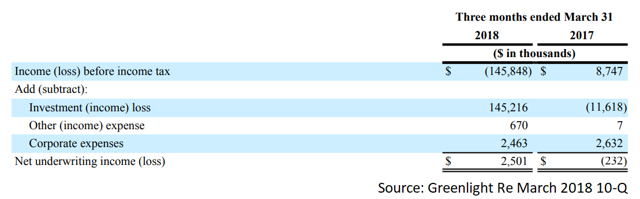
Greenlight March 18 Underwriting Profit

As you can see, the losses posted by Greenlight Re are fully attributable to its investment portfolio, which lost $145 million net of fees and expenses in this same period. These losses continued in April with another 0.5% detraction to the investment portfolio.

Einhorn is known for his long-short investing strategy, which led to marked outperformance during the last financial crisis. However, his recent performance, particularly in the last year, have been dismal compared to the overall market. In these three months, total losses in Greenlight Re's investments were 11.8% with the long and short portions of the portfolio contributing about equally to these losses. These results follow a tepid 0.9% net investment return for the 2017 calendar year while the S&P 500 (SPY) returned over 21%.

The biggest contributors to these declines were a short position in Netflix (NFLX), which gained 54% in the first quarter of 2018, and a long position in General Motors (GM), which lost 10%. Einhorn has been especially bearish the past few years on many high-flying tech names such as Netflix (NFLX) and Tesla (TSLA), which he shorts as part of his so-called "bubble basket".

An Opportunity to Invest Alongside an Underperforming Manager

Academic research has shown that managers that have underperformed over the past 3 and 5 year periods end up overperforming in the subsequent 3 and 5 year periods, what can be explained as a form of mean reversion in the best performing investment strategy. David Einhorn, with his long-short strategy, has been a perennial underperformer relative to the S&P 500 (SPY) since 2008/2009 where his portfolio strategy provided a buffer against the large losses posted during the last financial crisis. If you share an investment thesis with Einhorn, then investing in Greenlight Re could act as a hedge on the froth in the market, particularly in the technology sector.

So what is currently in Greenlight Re's portfolio?

As of December 2017, Greenlight Re's major (10%+) long positions were General Motors (GM), Brighthouse Financial (BHF), gold (GLD), Bayer (OTCPK:BAYZF), and Mylan (MYL). It also holds a long position in Micron (MU), which was the best positive contributor to its portfolio in the first quarter of 2018. These long positions were balanced by shorts in Tesla (TSLA), Netflix (NFLX), and other "bubble basket" stocks. The portfolio is also short Assured Guaranty (AGO), a municipal bond insurer, a position which is hedged by a simultaneous long in Puerto Rican debt. Overall, the portfolio is 93% gross long and 65% gross short. Unlike most insurance portfolios, just 0.5% of investments are in debt instruments and, in fact, Greenlight Re's short portfolio was 11% allocated to sovereign debt.

The long portfolio has a significant value-tilt. General Motors (GM), Brighthouse (BHF), and Mylan (MYL) all have forward P/E ratios < 7 and free cash flow yields > 10%. The short portfolio is comprised mainly of high growth names and other individual theses that Einhorn holds. Assured Guaranty (AGO) is not a growth stock but is shorted by Einhorn on his view that it lacks the financial strength to overcome its exposure to municipal debt, particularly that of Illinois and Puerto Rico.

Despite the fees charged to the investment portfolio, investing with Einhorn through Greenlight Re may be a compelling opportunity. The portfolio is not just randomly long-short but tries to take advantage of specific opportunities rather than simply being hedged to the fluctuations of the market. You get the benefit of exposure to the investment research of a hedge fund with a portfolio that is unlikely to be correlated with the overall market. If you generally agree with Einhorn's investment strategy or would like exposure to a long-short portfolio, Greenlight Re could act as a replacement to a pure investment in a hedge fund.

A further incentive to invest now is the discount to book value, which is currently 17%. The company itself recognizes this disparity between book and share price and has recommitted to a share repurchase program, which may help to narrow this gap in the short- to medium-term. As noted above, Greenlight Re has a loss carry forward provision with Einhorn and DME Advisors. The agreement is structured such that the 20% performance fee on net profits is reduced to 10% until 250% of the loss is recouped. Combined, a purchase at current prices (< $15.5 per share) gives a significant discount to exposure to Greenlight Re's investment portfolio and to a functional fee discount on potential future portfolio returns. Greenlight Re can be comfortably held in a taxable account as it currently pays no dividends.

Is the Insurance Vehicle a Boon or a Bane?

Buffett's deployment of insurance float to great success depended on the profitability of his underwriting business, and has lowered his exposure to reinsurance. In his 2017 annual letter, he warns on the long-tailed losses possible in property and casualty insurance that may not become apparent for many years. In this regard, Greenlight Re is relatively shielded from catastrophic losses as it largely exposed to shorter term policies such as motor liability. But, just how good is Greenlight Re's insurance business, to which an investor in the common stock of GLRE must be exposed in order to "access" Einhorn?

Because Greenlight Re's policies are generally short term, underwriting profits (and losses) should be reflected quickly in their financials. Unfortunately, despite profitability in the first quarter of this year, the past four fiscal years have all recorded underwriting losses and combined ratios greater than 100%:
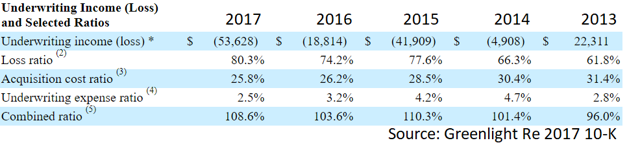
Greenlight Underwriting

If Greenlight Re is losing money as it tries to generate float, an investment in the common at a book value discount may actually be a mark of market efficiency rather. However, if you believe that the most recent results and efforts on higher quality and more profitable underwriting described in Greenlight Re's last conference call, then perhaps the discount is unwarranted. Greenlight Re has recently entered into new insurance markets in London, an area where its executives claim they have particular expertise.

On a positive note, unlike many larger insurers that are struggling to profitably invest their float in a low yield environment, Greenlight Re is unrestricted in its investments and has practically no exposure to fixed income beyond cash equivalents. You are, in fact, getting significant exposure to Einhorn's investment strategy if Greenlight Re can continue to shore up its underwriting business.

Conclusion

Greenlight Re is an opportunity to invest in a permanent capital vehicle alongside David Einhorn that appears to be improving its underwriting business. The stock gives combined exposure to the reinsurance business and a long-short hedge fund portfolio at a discount to book value with heavy exposure to value.

Disclosure: I/we have no positions in any stocks mentioned, but may initiate a long position in GLRE over the next 72 hours.

I wrote this article myself, and it expresses my own opinions. I am not receiving compensation for it (other than from Seeking Alpha). I have no business relationship with any company whose stock is mentioned in this article.

Sunday, May 20, 2018

Best Small Cap Stocks To Own For 2018

tags:CNR,PQ,FCEL,ACHN,

Yesterday, our Under the Radar Movers newsletter suggested small cap agricultural biotechnology Arcadia Biosciences (NASDAQ: RKDA) as a short/bearish trade:

��Arcadia Biosciences is just a straight-forward bearish momentum trade, and the chart speaks for itself. The clincher is the fact that the selling volume is surging today. You only have to go back to April and May to see what can happen once this stock picks up a head of steam. All the same, we'll be applying stops early and often here.��

Our Under the Radar Movers newsletter would have a further discussion of Arcadia Biosciences�� technical chart along with a potential short/bearish trading strategy:

Best Small Cap Stocks To Own For 2018: China Metro-Rural Holdings Limited(CNR)

Advisors' Opinion:
  • [By Shane Hupp]

    Wall Street analysts expect that Canadian National Railway (NYSE:CNI) (TSE:CNR) will announce $1.02 earnings per share (EPS) for the current quarter, according to Zacks Investment Research. Seven analysts have provided estimates for Canadian National Railway’s earnings, with the highest EPS estimate coming in at $1.06 and the lowest estimate coming in at $0.97. Canadian National Railway reported earnings per share of $1.00 in the same quarter last year, which would suggest a positive year over year growth rate of 2%. The company is expected to announce its next quarterly earnings results on Tuesday, July 24th.

  • [By Max Byerly]

    Canadian National Railway (NYSE:CNI) (TSE:CNR) – Cormark raised their Q3 2018 earnings per share (EPS) estimates for Canadian National Railway in a research report issued to clients and investors on Tuesday, April 10th. Cormark analyst D. Tyerman now expects that the transportation company will post earnings per share of $1.15 for the quarter, up from their previous estimate of $1.14.

Best Small Cap Stocks To Own For 2018: Petroquest Energy Inc(PQ)

Advisors' Opinion:
  • [By Ethan Ryder]

    News headlines about Petroquest Energy (NYSE:PQ) have been trending somewhat positive recently, Accern Sentiment Analysis reports. Accern identifies negative and positive news coverage by reviewing more than 20 million blog and news sources. Accern ranks coverage of publicly-traded companies on a scale of -1 to 1, with scores nearest to one being the most favorable. Petroquest Energy earned a coverage optimism score of 0.05 on Accern’s scale. Accern also gave news stories about the energy company an impact score of 47.638327846877 out of 100, meaning that recent news coverage is somewhat unlikely to have an impact on the company’s share price in the near future.

Best Small Cap Stocks To Own For 2018: FuelCell Energy Inc.(FCEL)

Advisors' Opinion:
  • [By Peter Graham]

    Small cap fuel cell stock�FuelCell Energy Inc (NASDAQ: FCEL) reported Q4 and fiscal year ended October 31, 2017 earnings�with�Q4 total revenues�being $47.9 million versus $24.5 million:����

  • [By Logan Wallace]

    FuelCell Energy (NASDAQ: FCEL) and HRG Group (NYSE:HRG) are both oils/energy companies, but which is the superior business? We will compare the two businesses based on the strength of their dividends, valuation, risk, analyst recommendations, institutional ownership, earnings and profitability.

  • [By Paul Ausick]

    FuelCell Energy Inc. (NASDAQ: FCEL) posted a decrease of 25.7% in short interest during the period. Some 5.86 million shares were short as of April 30. The stock closed at $1.93 on Wednesday, up about 1.6% for the day, in a 52-week range of $0.80 to $2.49. Shares traded down about 7.8% in the short interest period, and days to cover rose from six to eight.

  • [By Shane Hupp]

    FuelCell Energy (NASDAQ: FCEL) is one of 25 public companies in the “Miscellaneous electrical machinery, equipment, & supplies” industry, but how does it contrast to its peers? We will compare FuelCell Energy to related companies based on the strength of its risk, dividends, earnings, valuation, profitability, analyst recommendations and institutional ownership.

Best Small Cap Stocks To Own For 2018: Achillion Pharmaceuticals Inc.(ACHN)

Advisors' Opinion:
  • [By Stephan Byrd]

    Achillion Pharmaceuticals (NASDAQ:ACHN) has been given an average recommendation of “Hold” by the nine brokerages that are currently covering the firm, MarketBeat reports. Two analysts have rated the stock with a sell rating, four have issued a hold rating and three have issued a buy rating on the company. The average 12 month price target among analysts that have covered the stock in the last year is $5.20.

  • [By Stephan Byrd]

    Get a free copy of the Zacks research report on Achillion Pharmaceuticals (ACHN)

    For more information about research offerings from Zacks Investment Research, visit Zacks.com

  • [By Ethan Ryder]

    Achillion Pharmaceuticals (NASDAQ:ACHN) – Research analysts at B. Riley reduced their FY2018 EPS estimates for shares of Achillion Pharmaceuticals in a research note issued to investors on Wednesday, May 2nd. B. Riley analyst M. Kumar now anticipates that the biopharmaceutical company will earn ($0.58) per share for the year, down from their previous estimate of ($0.55). B. Riley has a “Neutral” rating and a $3.50 price objective on the stock. B. Riley also issued estimates for Achillion Pharmaceuticals’ FY2019 earnings at ($0.64) EPS, FY2020 earnings at ($0.71) EPS, FY2021 earnings at ($0.70) EPS and FY2022 earnings at ($0.84) EPS.

Saturday, May 19, 2018

$458.33 Million in Sales Expected for Diamondback Energy (FANG) This Quarter

Analysts predict that Diamondback Energy (NASDAQ:FANG) will post $458.33 million in sales for the current quarter, Zacks reports. Fourteen analysts have made estimates for Diamondback Energy’s earnings. The highest sales estimate is $508.00 million and the lowest is $410.00 million. Diamondback Energy posted sales of $269.43 million in the same quarter last year, which suggests a positive year-over-year growth rate of 70.1%. The company is scheduled to issue its next earnings results on Tuesday, August 7th.

On average, analysts expect that Diamondback Energy will report full-year sales of $1.93 billion for the current year, with estimates ranging from $1.73 billion to $2.17 billion. For the next financial year, analysts expect that the company will post sales of $2.54 billion per share, with estimates ranging from $2.33 billion to $2.98 billion. Zacks Investment Research’s sales calculations are an average based on a survey of research firms that cover Diamondback Energy.

Get Diamondback Energy alerts:

Diamondback Energy (NASDAQ:FANG) last announced its quarterly earnings results on Tuesday, May 8th. The oil and natural gas company reported $1.64 earnings per share (EPS) for the quarter, beating the Thomson Reuters’ consensus estimate of $1.59 by $0.05. The firm had revenue of $480.20 million for the quarter, compared to analyst estimates of $445.78 million. Diamondback Energy had a net margin of 35.09% and a return on equity of 10.53%. The business’s revenue for the quarter was up 104.1% on a year-over-year basis. During the same quarter in the previous year, the firm posted $1.04 EPS.

FANG has been the topic of several analyst reports. Zacks Investment Research lowered shares of Diamondback Energy from a “buy” rating to a “hold” rating in a report on Thursday, January 18th. Roth Capital boosted their target price on shares of Diamondback Energy from $120.00 to $145.00 and gave the company a “buy” rating in a research note on Monday, January 22nd. Morgan Stanley reduced their target price on shares of Diamondback Energy to $159.00 and set an “overweight” rating on the stock in a research note on Friday, April 20th. Credit Suisse Group set a $143.00 target price on shares of Diamondback Energy and gave the company a “buy” rating in a research note on Tuesday, January 23rd. They noted that the move was a valuation call. Finally, KeyCorp set a $137.00 target price on shares of Diamondback Energy and gave the company a “buy” rating in a research note on Sunday, January 21st. Three equities research analysts have rated the stock with a hold rating and twenty-six have issued a buy rating to the company. The stock presently has an average rating of “Buy” and an average target price of $142.04.

Shares of Diamondback Energy opened at $136.26 on Friday, MarketBeat Ratings reports. The firm has a market capitalization of $12.67 billion, a price-to-earnings ratio of 25.71, a price-to-earnings-growth ratio of 0.69 and a beta of 0.84. The company has a debt-to-equity ratio of 0.30, a quick ratio of 0.52 and a current ratio of 0.53. Diamondback Energy has a 52-week low of $128.00 and a 52-week high of $130.10.

The business also recently declared a special dividend, which will be paid on Tuesday, May 29th. Investors of record on Monday, May 21st will be given a dividend of $0.125 per share. The ex-dividend date of this dividend is Friday, May 18th.

In related news, CFO Teresa L. Dick sold 2,500 shares of the company’s stock in a transaction dated Monday, March 5th. The shares were sold at an average price of $130.97, for a total transaction of $327,425.00. The sale was disclosed in a filing with the SEC, which is accessible through the SEC website. Also, VP Randall J. Holder sold 7,120 shares of the company’s stock in a transaction dated Thursday, February 22nd. The stock was sold at an average price of $124.15, for a total transaction of $883,948.00. The disclosure for this sale can be found here. In the last quarter, insiders have sold 12,620 shares of company stock worth $1,567,773. 0.41% of the stock is owned by corporate insiders.

A number of hedge funds and other institutional investors have recently modified their holdings of the stock. Next Century Growth Investors LLC bought a new stake in Diamondback Energy during the 1st quarter worth about $121,000. ClariVest Asset Management LLC raised its holdings in Diamondback Energy by 14,557.1% during the 1st quarter. ClariVest Asset Management LLC now owns 1,026 shares of the oil and natural gas company’s stock worth $130,000 after purchasing an additional 1,019 shares during the last quarter. Signaturefd LLC bought a new stake in Diamondback Energy during the 1st quarter worth about $132,000. Zions Bancorporation bought a new stake in Diamondback Energy during the 1st quarter worth about $136,000. Finally, Captrust Financial Advisors bought a new stake in Diamondback Energy during the 4th quarter worth about $149,000.

Diamondback Energy Company Profile

Diamondback Energy, Inc, an independent oil and natural gas company, focuses on the acquisition, development, exploration, and exploitation of onshore oil and natural gas reserves in the Permian Basin in West Texas. Its activities are primarily focused on the Wolfcamp, Spraberry, Clearfork, Bone Spring, and Cline formations.

Get a free copy of the Zacks research report on Diamondback Energy (FANG)

For more information about research offerings from Zacks Investment Research, visit Zacks.com

Earnings History and Estimates for Diamondback Energy (NASDAQ:FANG)